


Choosing the right intermodal provider for your business needs is a nuanced decision in today's freight world complete with capacity swings, tariff volatility and cross-border complexity. Many shippers assume that owning equipment equals superiority - buying into a persistent logistics myth that asset-based providers offer inherently better reliability, cost or control.
The thinking goes: "If they own the containers, they must be more committed. They must have better control. They must be the safer choice." But flexibility, resilience, and visibility are everything - and asset ownership doesn't automatically deliver those outcomes.
This article aims to be the definitive resource for shippers evaluating intermodal providers. We'll cover:
- What "asset" and "non-asset" actually mean in intermodal (it's not what you think)
- The real advantages of each model
- The myths that mislead shippers
- When to use asset providers, when to use non-asset, and when to use both
- How to evaluate any IMC, regardless of model
I've written extensively about this topic on my LinkedIn and here, on the InTek Logistics website. And I've noticed something: most content about IMCs pushes hard toward asset providers. That's great for some shippers.
But it's not the full picture, and it's causing many shippers to miss out on capacity, savings, and service options they don't even know exist. By reading this article, you'll have the knowledge to make an informed decision —one that fits your network, your lanes, and your business objectives.
Part 1: Understanding the Intermodal Provider Landscape
First, Let's Clear Up the Biggest Misconception
In truckload, "asset vs. non-asset" is straightforward:
- Asset carriers own trucks and employ drivers
- Non-asset brokers arrange capacity from carriers they don't own
Simple. Clean. Easy to understand.
Intermodal is completely different.
Here's the key insight most shippers miss: No single company owns all the assets in an intermodal move.
Not J.B. Hunt. Not Hub Group. Not Schneider. Not Swift. Not STG. Not the class 1 railroads. Not anyone.
An intermodal shipment involves:
- Origin drayage (truck)
- Ramp-in at origin terminal
- Rail linehaul
- Ramp-out at destination terminal
- Destination drayage (truck)
The tracks, trains, locomotives, and intermodal ramps are owned 100% by the Class I railroads.
No IMC, asset or non-asset, owns any of that infrastructure.
So when we talk about "asset" vs. "non-asset" in intermodal, we're really talking about who owns the containers and drayage capacity. That's it.
The Types of Intermodal Marketing Companies
The 53' domestic intermodal market includes several types of providers:
1. Bi-Modal IMCs (Asset-Based)
These providers own containers, chassis, and the majority of their drayage capacity (tractors and drivers). J.B. Hunt is the dominant example, with approximately 116,000 containers, which is the largest fleet in North America.
Other bi-modal providers include Hub Group (approximately 50,000 containers), Schneider, and Knight-Swift.
Key characteristics:
- Own containers and most drayage assets
- Have contractual commitments with specific railroads
- Typically align with one West Coast railroad (BNSF or UP) and one East Coast railroad (NS or CSX)
- Strong on high-volume, high-density lanes within their network
2. Asset-Lite IMCs
These providers own some containers and drayage capacity but also utilize railroad-owned equipment when demand exceeds their owned capacity. Schneider operates in this model for portions of their business.
3. Non-Asset IMCs
These providers do not own containers or drayage assets. Instead, they have contractual relationships with all North American Class 1 railroads to utilize railroad-owned equipment.
Key characteristics:
- Direct contractual relationships with UP, NS, CSX, BNSF, CN, and CPKC
- Access to approximately 88,000+ railroad-owned containers
- Access to private box owners
- In certain situations, they also tap into some of the asset container pools. (I realize that sounds odd, but to add to it there are times asset providers work through a non-asset for capacity to help balance a lane for them.)
- Relationships with extensive networks of drayage carriers
- Can serve any intermodal lane in North America
- Utilize 40 foot ISO containers for repositioning programs that use import containers that would otherwise move empty to exporters or to port cities. Extremely competitive rates for shippers.
4. Rail Retailers
Canadian National (CN) and Canadian Pacific Kansas City (CPKC) sell directly to some shippers. While their service is solid, many shippers find the direct railroad model lacks the customer service and operational support of an IMC.
5. Freight Brokers
Brokers that don't purchase rail service directly from railroads are not true IMCs. They work through IMCs to arrange intermodal capacity. This adds a layer between the shipper and the railroad, often without the intermodal expertise that dedicated IMCs provide.
The Container Ownership Breakdown
Understanding who owns what helps clarify the market:
| Owner | Approximate Containers | % of Market |
|---|---|---|
| J.B. Hunt | ~116,000 | Largest single owner |
| Hub Group | ~50,000 | Second largest |
| Schneider | ~27,700 | Third largest |
| Class 1 Railroads (combined) | ~88,000+ | UP, NS, CSX own containers; BNSF does not |
| Other Asset IMCs | Varies | STG, Knight-Swift, others |
Or for more colorful breakdowns of container ownership:
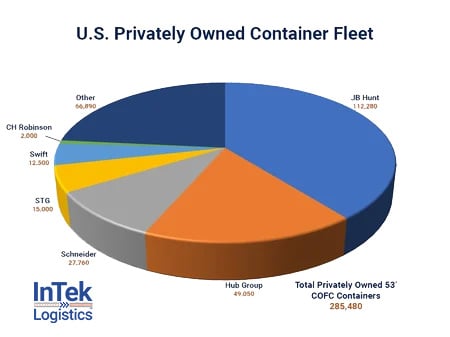
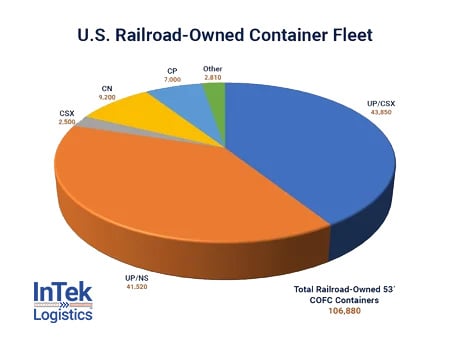
Key insight: Approximately 33% of containers are publicly owned (by railroads) and available to non-asset IMCs. This is substantial capacity that many shippers don't even know exists.
Part 2: The Case for Asset-Based IMCs
Let's be clear: asset-based IMCs provide tremendous value to the right shippers. Here's where they excel.
Strengths of Asset-Based Providers
1. Network Density on Core Lanes
Asset IMCs like J.B. Hunt have built their networks around high-volume, high-density lanes. On these core corridors - LA to Chicago, LA to Dallas, Chicago to the Northeast - they achieve excellent equipment utilization and can offer competitive pricing.
If your freight flows align with their network sweet spots, asset providers can be hard to beat when it comes to price.
2. Economies of Scale
J.B. Hunt handles over 2 million intermodal loads annually. That scale creates purchasing power with railroads, chassis pools, and drayage providers. On lanes where they have density, they can achieve economies that smaller providers cannot match.
3. Integrated Operations
Because bi-modals own their drayage capacity, they have more direct control over the first and last mile. When everything works within their system, handoffs can be seamless.
4. Brand Recognition and Stability
J.B. Hunt, Hub Group, and Schneider are publicly traded companies with decades of intermodal experience. For procurement teams, these are "safe" choices that require less explanation to leadership.
5. Truckload Balance Opportunities
Asset providers with significant truckload operations (like J.B. Hunt, Schneider, and Knight-Swift) can sometimes offer unconventional intermodal lanes by balancing intermodal with their truckload network.
When Asset Providers Are the Right Choice
Asset-based IMCs tend to work best when:
- Your freight aligns with their high-volume network lanes
- You have significant, consistent volume on a limited number of corridors
- You value brand recognition and prefer working with household names
- Your lanes happen to be their "sweet spot" lanes where they achieve maximum efficiency
- You're a very large shipper who can command dedicated attention from their operations team
Part 3: The Case for Non-Asset IMCs
Now let's address what I believe is the most misunderstood segment of the intermodal market.
A Non-Asset IMC Is NOT "Just Another Broker"
This is the most damaging myth in intermodal. Let me explain why it's wrong.
A true non-asset IMC has direct, contractual relationships with the Class 1 railroads. The railroads don't sell intermodal service directly to most shippers, so they sell wholesale to IMCs who then market, sell, and operate the service.
Union Pacific, Norfolk Southern, and CSX own containers that they market through non-asset IMCs. These IMCs are not brokering someone else's capacity. They are the authorized sales, marketing, and operations channel for railroad-owned equipment.
The non-asset IMC contractual commitment is a binding three-way agreement between the IMC, shipper, and railroad. This provides:
- Year-round capacity commitments
- Contracted pricing
- Protection against peak season surcharges
- Direct railroad backing
A non-asset IMC has the full faith and backing of the railroad's resources.
A freight broker working through an IMC does not have this relationship.
Strengths of Non-Asset Providers
1. Access to All Class 1 Railroads
Non-asset IMCs have relationships with UP, NS, CSX, BNSF, CN, and CPKC. This means they can serve any intermodal lane in North America, not just the lanes that fit one railroad's network.
Asset providers typically align with specific railroads. J.B. Hunt, for example, partners primarily with BNSF in the West and Norfolk Southern in the East (at least for now). If a lane doesn't fit their railroad partnerships, they may not be competitive or may not offer it at all.
2. Flexibility to Shift Between Railroads
When one railroad experiences service disruptions - a derailment, terminal congestion, weather impacts - a non-asset IMC can shift freight to an alternative railroad.
Example: If UP has a derailment affecting service from LA to Chicago, a non-asset IMC can move freight via BNSF using railroad-owned or private containers. An asset provider locked into UP has no alternative but to wait.
This flexibility is invaluable in a market where rail service disruptions are inevitable.
3. Network-Wide Coverage
Asset IMCs optimize their networks around their highest-volume lanes. Lanes that don't generate sufficient density for their model may receive secondary attention or may not be offered at all.
Non-asset IMCs can profitably serve lanes across the entire North American intermodal network, including:
- Secondary markets with lower volume
- Cross-border lanes (US-Mexico, US-Canada)
- TOFC (trailer-on-flatcar) options - yes this option still exist in extremely tight freight markets
- ISO container repositioning programs (40' and 45' ocean containers)
4. Superior Customer Service (Documented)
This isn't opinion - it's documented in industry surveys.
The Journal of Commerce (JOC) consistently surveys the intermodal market, asking shippers to rank their IMCs. Time and again, mid-market non-asset IMCs lead the pack, earning the highest Net Promoter Scores (NPS).
In the JOC's Intermodal Service Scorecard:
- Shippers rated mid-market IMCs first and J.B. Hunt second in four of six key performance indicators
- Customer service was ranked as most important to shippers
- The reason: mid-market non-asset IMCs deliver personalized service that larger companies often can't match - and have service options for every available intermodal lane in North America. (Again, the asset providers do not have this option because they align with specific railroads and all Class I railroads to no have ramps in the same cities.)
One shipper wrote: "Our IMC communicates well and is a great long-term partner, so while their rates may be a little higher, their service is excellent."
5. Technology Investment
Because non-asset IMCs don't have capital tied up in containers, trucks, and chassis, they often invest more heavily in technology:
- Real-time visibility platforms
- Data analytics and reporting
- TMS integrations
- Predictive ETA modeling
This technology investment can provide visibility and control that matches or exceeds what asset providers offer.
6. Ability to Augment with Truckload
When a lane doesn't fit intermodal or service requires a faster option, non-asset IMCs can seamlessly provide truckload alternatives. This "one-stop shop" model means shippers don't need separate relationships for intermodal and truckload.
7. No Network Rationalization Pressure
Asset providers are publicly traded companies with quarterly earnings pressure. During and after capacity-constrained markets, they often rationalize their networks focusing on high-yield lanes and deprioritizing lower-margin business.
Non-asset IMCs don't face the same pressure to optimize for container turns and yield management. They can maintain service on a broader range of lanes without the same financial dynamics pushing them to concentrate only on their best-performing corridors.
When Non-Asset Providers Are the Right Choice
Non-asset IMCs tend to work best when:
- Your freight spans diverse lanes across multiple regions
- You need flexibility to shift between railroads when service disruptions occur
- You value personalized customer service and direct access to decision-makers
- You're a small-to-mid-sized shipper who might not command premium attention from the largest providers
- You need coverage on lanes that don't fit asset providers' core networks
- You want a single provider for your complete intermodal needs across North America
- You need the flexibility to augment intermodal with truckload when required
Part 4: Dispelling the Top Myths About Non-Asset Providers
Myth 1: "Asset Providers Are Always Cheaper"
Why the myth persists: Shippers assume owning containers, chassis, and rail assets lowers cost by cutting out middlemen.
Reality: Cost depends far more on network density, lane optimization, and asset utilization than ownership.
A non-asset IMC can selectively tap the best railroad or dray partner for a given lane, optimizing cost and service. When one railroad is tight or a dray provider is disrupted, non-asset providers can shift to alternate partners, thus avoiding uplift or delay.
Asset providers may have lower costs on their core network lanes, but they may be more expensive on lanes where they lack density or railroad alignment.
Shipper question to ask: "If my lane's primary railroad experiences disruption, what backup capacity do you have, and at what cost?"
Myth 2: "Non-Asset Providers Have No Control Over Service"
Why the myth persists: "Non-asset = broker" sounds like low accountability.
Reality: The top non-asset IMCs function as orchestration engines. They consolidate performance data, monitor service SLAs, and enforce accountability across partners.
A well-run non-asset IMC maintains scorecards for all dray providers and rail segments, triggers escalation workflows, and holds partners to minimum reliability thresholds.
When an origin dray partner misses a terminal cut, a good non-asset IMC auto-reassigns a backup and adjusts downstream rail bookings, not waiting for manual escalation. That agility ensures freight doesn't stay stuck.
Shipper question to ask: "Show me your partner performance metrics and escalation process when a leg underperforms."
Myth 3: "Visibility Is Better If You Own the Assets"
Why the myth persists: People think "we own the container = we see everything."
Reality: Owning assets doesn't guarantee integrated tracking. Many asset providers still depend on disparate legacy systems.
A strong non-asset IMC invests in a neutral, aggregated visibility platform that draws from rail, dray, GPS, sensor, and ELD feeds. The result: a single, synchronized "source of truth" for shipment status, regardless of which partner moves it.
Your container's live location might draw from UP's rail GPS, your dray's ELD, and door-open sensor alerts—all collated in one interface. No "you ask carrier A, I ask carrier B" siloed view.
Shipper question to ask: "Can I see my shipment across all modes and carriers in one dashboard?"
Myth 4: "Non-Asset Providers Are Just Middlemen"
Why the myth persists: Desk brokers and load-matchers give non-asset models a bad reputation.
Reality: A modern non-asset IMC is a strategic systems integrator. They combine supply chain design, rate engineering, compliance management, cross-dock infrastructure, and operational oversight into a cohesive solution.
They're not just moving boxes - they're designing lane networks, mitigating tariff exposure, and optimizing visibility across complex supply chains.
Competitive differentiation includes:
- Access to multiple Class 1 railroads and interline options
- Ability to scale with seasonal demand without asset capital constraints
- Flexibility to deploy inland transload, multi-tier dray, or bonded warehouse strategies
- Access to TOFC and ISO repositioning programs
Shipper question to ask: "How do you architect networks beyond single lanes to create economies of scale and risk mitigation?"
Myth 5: "Owning Your Fleet Means Better Reliability"
Why the myth persists: Asset control feels more stable - "if you own it, you control it."
Reality: Assets don't guarantee flexibility. When your own containers or chassis are tied up elsewhere, they're not available for your load. Asset providers can find themselves short on equipment in exactly the markets where you need it.
Non-asset IMCs maintain access to diverse equipment pools and can shift capacity preemptively when markets tighten.
Example: During chassis shortages in Southern California, many asset providers scrambled to source external equipment and passed cost increases to shippers. Non-asset IMCs with broader access were able to reroute or rebalance loads without service interruption.
Shipper question to ask: "In peak seasons, how do you maintain capacity continuity without equipment lock-in?"
Part 5: The Hybrid Approach—Why Many Shippers Use Both
Here's what we've found after working with hundreds of shippers:
Large shippers typically go with a "best of breed" solution diversifying across both asset and non-asset IMCs to give diversify away risk on one railroad, to account for different intermodal freight lanes, and to align service requirements of their customers.
Smaller to mid-sized shippers often choose non-asset IMCs for the simplicity of having one provider for all their intermodal needs.
Why Diversification Makes Sense
1. Leverage on Pricing
On lanes where both UP and BNSF (or NS and CSX) operate, shippers gain leverage when they can move freight via multiple railroads. Non-asset IMCs provide that flexibility. Using only an asset provider locked into specific railroads limits your negotiating position.
2. Service Redundancy
When one provider or railroad has service issues, having an alternative keeps freight moving. A shipper using only J.B. Hunt has no backup if BNSF or NS experiences problems. Adding a non-asset IMC creates redundancy.
3. Lane-Specific Optimization
Different providers excel on different lanes. An asset provider might be the best option for LA to Chicago. A non-asset IMC might be better for a secondary lane. Using both lets you optimize lane by lane.
4. Customer Service Balance
Large asset providers may provide excellent service to their largest customers but struggle to deliver the same attention to mid-market shippers. Adding a non-asset IMC ensures you have a provider where your business matters.
The Recommended Approach by Shipper Size
Large Shippers (1,000+ intermodal loads/month)
- Use asset providers on their core, high-volume lanes where they have network density
- Use non-asset IMCs for secondary lanes, flexibility, and railroad diversification
- Maintain 2-3 IMC relationships to ensure competitive tension and backup options
Mid-Market Shippers (100-1,000 loads/month)
- Consider non-asset IMCs as the primary provider for simplicity and full network coverage
- Add an asset provider if specific high-volume lanes align perfectly with their network
- Prioritize customer service and flexibility over brand recognition
Smaller Shippers (<100 loads/month)
- Non-asset IMCs are often the best fit
- Large asset providers may not prioritize your business at this volume, while non-asset IMCs still provide personalized service
- One provider for all North American lanes simplifies operations
Part 6: How to Evaluate Any IMC (Asset or Non-Asset)
Regardless of the model, here's how to assess any intermodal provider:
The Critical Evaluation Criteria
| Area | What to Ask / Look For |
|---|---|
| Network Access | Which Class 1 railroads do they work with? Can they serve all your lanes? |
| Service Oversight | What are their escalation workflows? Do they maintain partner scorecards? What's the backup plan when something goes wrong? |
| Visibility | Is there a unified dashboard? API/EDI integration available? Real-time alerts? |
| Customer Service | What's their responsiveness? Who's your day-to-day contact? What's their NPS score? |
| Flexibility / Scalability | Can they scale up/down without asset constraints? Can they shift between railroads? |
| Reliability | Historical KPIs? On-time delivery percentage? Disruption recovery examples? |
| Cost Transparency | Clear breakdowns (linehaul, dray, accessorials)? Rules for contingencies? Bundled pricing options? |
| Technology | Tracking capabilities? Data analytics? TMS integration? |
| References | Will they provide references from similar shippers? (A top IMC will share them quickly.) |
Questions Every Shipper Should Ask
For Asset Providers:
- What lanes are in your core network sweet spot?
- What happens when a lane doesn't fit your network? Do you still offer it?
- How do you handle service disruptions on your primary railroad?
- What percentage of your drayage is company-owned vs. outsourced?
- How do you prioritize service across your customer base?
For Non-Asset Providers:
- Which Class 1 railroads do you have direct contractual relationships with?
- How do you ensure consistent service across multiple dray providers?
- What technology do you use for visibility and tracking?
- How do you handle capacity during peak seasons?
- Can you provide references from shippers with similar freight profiles?
For Both:
- How do you define and measure success in the first 30-90 days?
- Who owns exceptions and what's the escalation path?
- What visibility do I get at dray/rail/handoff points?
- How do you prevent accessorial surprises?
- What are your best lanes and where should I NOT use intermodal?
- How do you handle claims and cargo risk protocols?
Part 7: The Bottom Line
What the Data Actually Shows
The Journal of Commerce surveys consistently reveal important patterns:
- Shippers rated mid-market (non-asset) IMCs first in five of six key performance indicators
- Customer service was ranked most important to shippers, followed by price competitiveness
- Nearly 88% of shippers were satisfied with their IMCs in recent surveys
- Non-asset IMCs earn the highest Net Promoter Scores, meaning shippers are more likely to recommend them
This doesn't mean asset providers are bad. J.B. Hunt consistently receives top marks for overall performance and scale.
But the data shows that non-asset providers deliver exceptional value that many shippers overlook.
The Real Differentiator: Service Quality, Not Asset Ownership
After nearly two decades helping shippers navigate intermodal, here's what I've learned:
The critical differentiator in intermodal services is not asset ownership - instead it's the ability to provide high-quality service.
A non-asset IMC with excellent communication, strong railroad relationships, robust technology, and responsive customer service will outperform an asset provider with poor execution every time.
Conversely, a well-run asset provider on their core network lanes will outperform a poorly managed non-asset IMC.
The model matters less than the execution.
My Recommendation
If you're a shipper evaluating intermodal providers:
- Don't default to asset providers just because they're familiar. You may be missing better options.
- Don't dismiss non-asset providers as "just brokers." They're the authorized sales channel for railroad-owned capacity, with direct railroad backing.
- Evaluate both models based on your specific lanes, volumes, and service requirements.
- Consider using both if you have diverse lanes optimize provider selection by corridor.
- Prioritize service quality over asset ownership in your decision-making.
- Ask for references and talk to shippers with similar freight profiles.
The best intermodal strategy is the one that fits your business, not the one that fits a marketing narrative.
Making Non-Asset IMCs Part of Your Strategy
I started this article by noting that most content about IMCs pushes toward asset providers. That's understandable: J.B. Hunt, Hub Group, Schneider, Swift and STG have significant marketing budgets and brand recognition.
But that narrative causes shippers to miss opportunities.
Non-asset IMCs offer:
- Access to all Class 1 railroads and the flexibility to shift when disruptions occur
- Superior customer service (documented in JOC surveys)
- Technology investment that rivals or exceeds asset providers
- Coverage on lanes that asset providers may not prioritize
- Contractual railroad backing with year-round capacity commitments
- The ability to serve as a one-stop shop for all North American intermodal
If you're currently using only asset providers, you may be leaving value on the table. If you've never considered a non-asset IMC because you assumed they were "just brokers," it's time to revisit that assumption.
The right intermodal strategy isn't about choosing sides. It's about finding the providers (asset, non-asset, or both) who deliver the outcomes your business needs. A well-engineered non-asset partner can give you the agility of a broker with the power of an integrated operator. They deserve a seat at the table.
If you're curious whether a non-asset IMC could improve your intermodal program - or how a diversified approach might strengthen your network - InTek Intermodal Logistics can help. Simply fill in our brief form and we'll be in touch before you know it to discuss your freight needs.
We've been helping shippers add intermodal capacity or transition truckload lanes to intermodal since 2007. With direct relationships with all North American Class 1 railroads and a focus on service that has earned us consistently high marks in JOC surveys, we offer the flexibility, visibility, and personalized attention that distinguishes the best non-asset providers.
Related Articles:
- Intermodal Marketing Company (IMC): Definition, Purpose & Value
- JB Hunt's Intermodal Model vs. Class I Railroads: Pros and Cons of Each
- Top Benefits of Using a Non-Asset Intermodal Provider
- Intermodal Options Beyond JB Hunt, Hub Group, Schneider, STG & Swift