



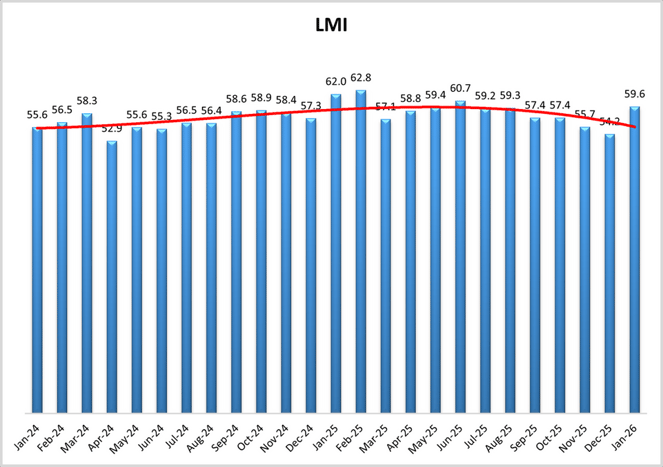
Was the new year a new beginning for the freight industry? January's Logistics Managers' Index (LMI) offers some hope in that regard, as it rose 5.2 points to 59.6 - bucking a steadily downward trend since it was last above 60 in June.
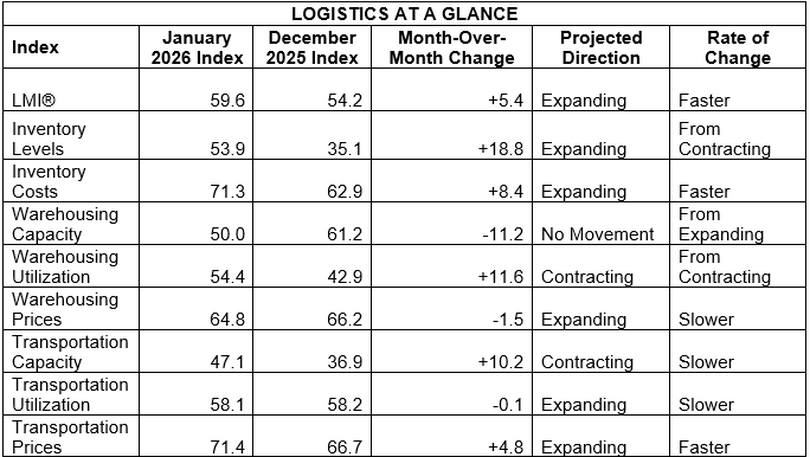
The news is generally good across the board in terms of individual metrics, with Transportation Capacity and Warehousing Capacity the only areas not expanding. But the big driver of momentum last month came from Inventory Levels, which jumped from a December low of 35.1 to 53.9 - a gain of 18.8, due to restocking activity following the holiday shopping season.
With that jump, Inventory Costs followed suit, rising 8.4 to 71.3. And the aforementioned Warehousing Capacity fell 11.2 to an even 50, while Warehousing Utilization went up almost the same amount (11.6) to 54.4, joining Inventory Levels in the rise from contraction to expansion. Warehousing Prices remain firmly in expansion as well, at 64.8, but that was a 1.5 point decline from December.
Interestingly, LMI authors note that this inventory restocking looks both less drastic and more sustainable than past years - potentially showing signs of more consistent, if not spectacular, volume for the coming year. January 2025 saw an Inventory Level reading nearly five points higher than this year and an overall LMI of 62, suggesting a more traditional stocking behavior (mostly before tariffs and pull-forward entered the equation).
This year's lower figure suggests a move toward more fluid stocking, allowing for more flexibility more along the lines of just-in-time (JIT) inventory behavior - which could also mean fewer air pockets and more steady freight volume this year at the expense of any explosive heights.
With the inventory behavior driving change, transportation metrics stayed encouragingly steady. Transportation Prices were up another 4.8 to 71.4, their best figure in nearly four years. Transportation Capacity did gain back some ground it lost last month, rising 10.2 to a still-contracting 47.1. And Transportation Utilization stayed essentially flat (-0.1) at 58.1. That paints a picture of relative tightness on the shipping side, and a generally healthy stance to begin 2026 - pending how much volume comes through as the year goes on.
And that leads us to what respondents expect to see as next year starts. Their outlook is similar to last month's, with the predicted January 2027 LMI reading at 65.8 (+0.5 from December). They project all three price metrics to be above 70 - the first time that would occur since the pandemic-peak period, while Inventory Levels would be slightly above where they are now at 60.9.
By the Numbers
See the summary of the January 2026 Logistics Managers' Index, by the numbers:
About the Logistics Managers' Index (LMI)
Researchers at Arizona State University, Colorado State University, Rochester Institute of Technology, Rutgers University, and the University of Nevada, Reno - in conjunction with the Council of Supply Chain Management Professionals (CSCMP) - issue the report. The LMI score is a combination of eight unique components that make up the logistics industry, including: inventory levels and costs, warehousing capacity, utilization, and prices, and transportation capacity, utilization, and prices.
The LMI is calculated using a diffusion index, in which any reading above 50.0 indicates that logistics is expanding; a reading below 50.0 is indicative of a shrinking logistics industry. The latest results of the LMI summarize the responses of supply chain professionals collected in January 2026. Learn more about the index on our podcast with its primary author Zac Rogers, Ph.D., associate professor of Supply Chain Management at Colorado State University.
Need assistance with your shipping operations? Request a quote with us, and we'll get back to you to discuss your unique needs. Go to our Freight Guides to learn more about everything freight and logistics. Additionally, visit our blog for information and updates on the freight industry.