


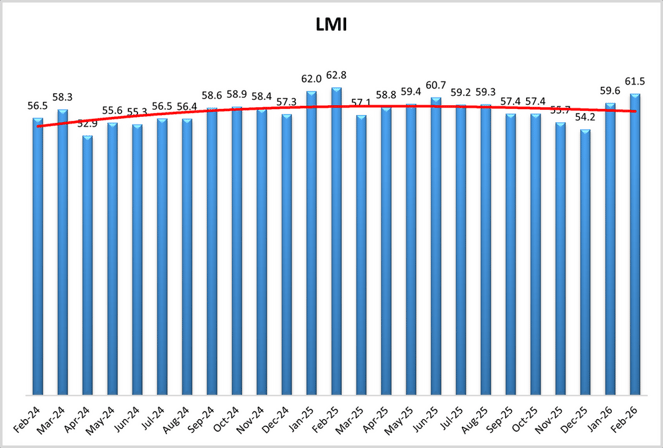
Last month and last February look quite similar on the surface for the Logistics Managers' Index (LMI), but a look under the hood shows quite different fundamentals. Expansion is consistent for both, as last month saw an overall LMI reading of 61.5 - up 1.9 from January and the first over 60 reading in eight months. But last February looked good too, at 62.8.
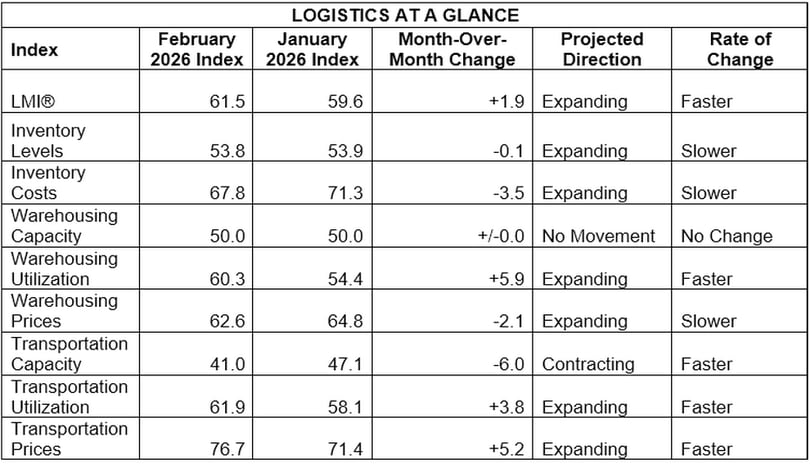
How they got to those figures is quite another story. This February's strength was driven by its transportation components, with Transportation Prices coming in at 76.7 (+5.2 from January), Transportation Capacity at 41 (-6 from January), and Transportation Utilization at 61.9 (+3.8 from January). To compare with 12 months prior, Transportation Prices were at 65.5 and Capacity at 55.1.
In February 2025, it was all about pull-forward, as LMI authors note that Inventory Levels were at 64.8 and Inventory Costs came in at 77.3 while shippers focused on building up product ahead of tariff implementation. This year, however, shippers are doing the opposite: keeping their stockpiles light to keep their costs from current tariffs down. Thus, Inventory Levels last month were at 53.8 (-0.1 from January) and Inventory Costs at 67.8 (-3.5 from January).
Rounding out the metrics for February 2026, Warehousing Capacity stayed flat month-to-month at an also not-moving 50. And Warehousing Prices fell 2.1 to 62.6.
Authors point out that tariff uncertainty continues following last month's Supreme Court ruling that the levies implemented under IEEPA authority were invalid (with an immediate follow-up by President Trump of a blanket 10% rate). That ruling, the tariff issue in general, the recently begun Iran conflict (and its side effects on oil and shipping routes) and various capacity factors affecting trucking mean there are plenty of variables impacting the freight industry moving forward.
So did respondents feel that uncertainty would be positive or negative for next year? The 12 months ahead projection continues to climb, with a February 2027 estimated LMI at 66.3, the second straight month that figure saw an increase of 0.5. The drivers behind it are still largely expected to be transportation metrics, with prices coming in at a whopping 80.9 with capacity remaining in contraction territory at 44.9. Warehousing capacity is expected to have continued tightness as well, while prices go up. And inventory metrics should see some growth from where they stand now.
By the Numbers
See the summary of the February 2026 Logistics Managers' Index, by the numbers:
About the Logistics Managers' Index (LMI)
Researchers at Arizona State University, Colorado State University, Rochester Institute of Technology, Rutgers University, and the University of Nevada, Reno - in conjunction with the Council of Supply Chain Management Professionals (CSCMP) - issue the report. The LMI score is a combination of eight unique components that make up the logistics industry, including: inventory levels and costs, warehousing capacity, utilization, and prices, and transportation capacity, utilization, and prices.
The LMI is calculated using a diffusion index, in which any reading above 50.0 indicates that logistics is expanding; a reading below 50.0 is indicative of a shrinking logistics industry. The latest results of the LMI summarize the responses of supply chain professionals collected in February 2026. Learn more about the index on our podcast with its primary author Zac Rogers, Ph.D., associate professor of Supply Chain Management at Colorado State University.
Need assistance with your shipping operations? Request a quote with us, and we'll get back to you to discuss your unique needs. Go to our Freight Guides to learn more about everything freight and logistics. Additionally, visit our blog for information and updates on the freight industry.