


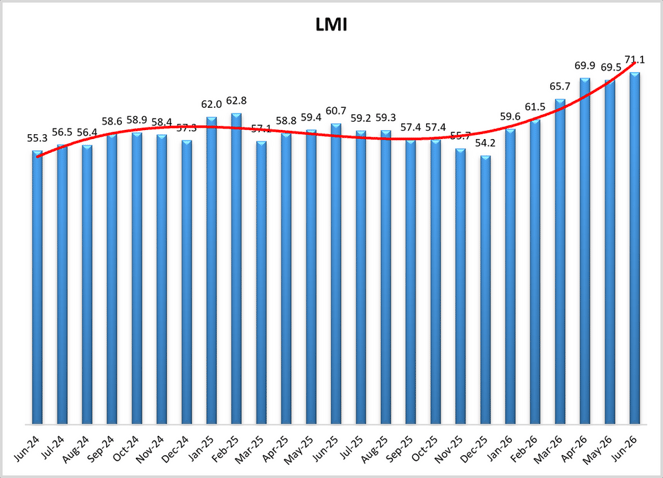
After a small blip in May, the Logistics Managers' Index (LMI) is back on the rise. Its 1.6 point increase may not seem like much, but it's led to the LMI crossing 70 (to 71.1) for the first time since March 2022. Authors note that 70 point benchmark represents a rate of significant expansion in the market.
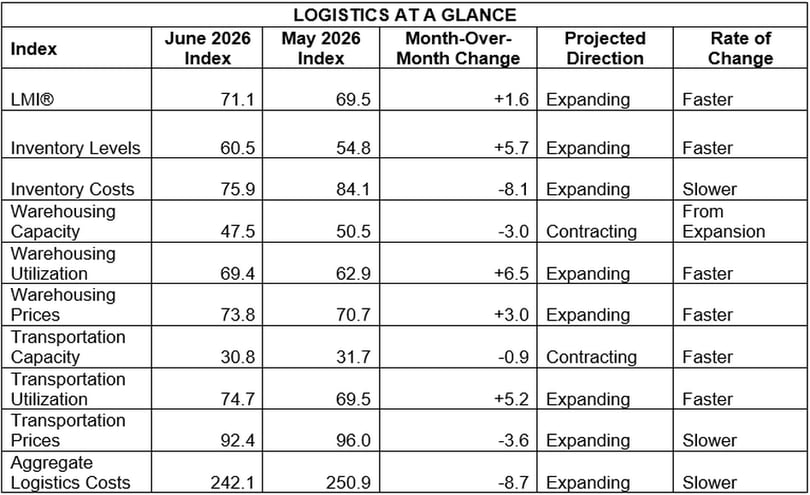
Encouragingly, the upward movement in June is led by Inventory Levels, which jumped 5.7 to 60.5, suggesting some volume activity helping out the overly supply driven freight landscape. Why is inventory gaining steam? The report lists both steady consumer spending in spite of inflation and worries about increased tariffs later in July (the seemingly never-going-away pull-forward term).
The expansion in that metric caused Warehousing Utilization to rise 6.5 to 69.4, Warehousing Capacity to dip back into contraction (-3 to 47.5), and Transportation Utilization to jump 5.2 to 74.7. Warehousing Prices responded by going up three points to 73.8, while Inventory Costs actually saw a major dip of 8.1 to 75.9.
As far as the key transportation metrics go, Transportation Prices remain especially high, though they dipped 3.6 off May's all-time record to a still quite robust 92.4. Transportation Capacity also fell, losing 0.9 to a new reading of 30.8. The spread between Prices and Capacity remains a substantial one, suggesting continued strength in that corner of the freight world.
Did the 70 point benchmark influence respondents' view of the future? Twelve months out, they expect the LMI to be very similar to where it is now, at 70.6. That's 1.2 points higher than their predictions in May. Freight pros are particularly bullish on Inventory Levels, which they have up to 67.7 in a year - a gain of 10.7 after last month saw a significant 8.5 point drop. Transportation Prices are expected to remain strong, though falling back a bit from their highs, while Capacity is expected to grow a bit but remain firmly in contraction.
By the Numbers
See the summary of the June 2026 Logistics Managers' Index, by the numbers:
About the Logistics Managers' Index (LMI)
Researchers at Arizona State University, Colorado State University, Rochester Institute of Technology, Rutgers University, and the University of Nevada, Reno - in conjunction with the Council of Supply Chain Management Professionals (CSCMP) - issue the report. The LMI score is a combination of eight unique components that make up the logistics industry, including: inventory levels and costs, warehousing capacity, utilization, and prices, and transportation capacity, utilization, and prices.
The LMI is calculated using a diffusion index, in which any reading above 50.0 indicates that logistics is expanding; a reading below 50.0 is indicative of a shrinking logistics industry. The latest results of the LMI summarize the responses of supply chain professionals collected in June 2026. Learn more about the index on our podcast with its primary author Zac Rogers, Ph.D., associate professor of Supply Chain Management at Colorado State University.
Need assistance with your shipping operations? Request a quote with us, and we'll get back to you to discuss your unique needs. Go to our Freight Guides to learn more about everything freight and logistics. Additionally, visit our blog for information and updates on the freight industry.