

Truckload• Intermodal Transportation• Logistics & Supply Chain• Logistics Service Provider• Transloading• IPI
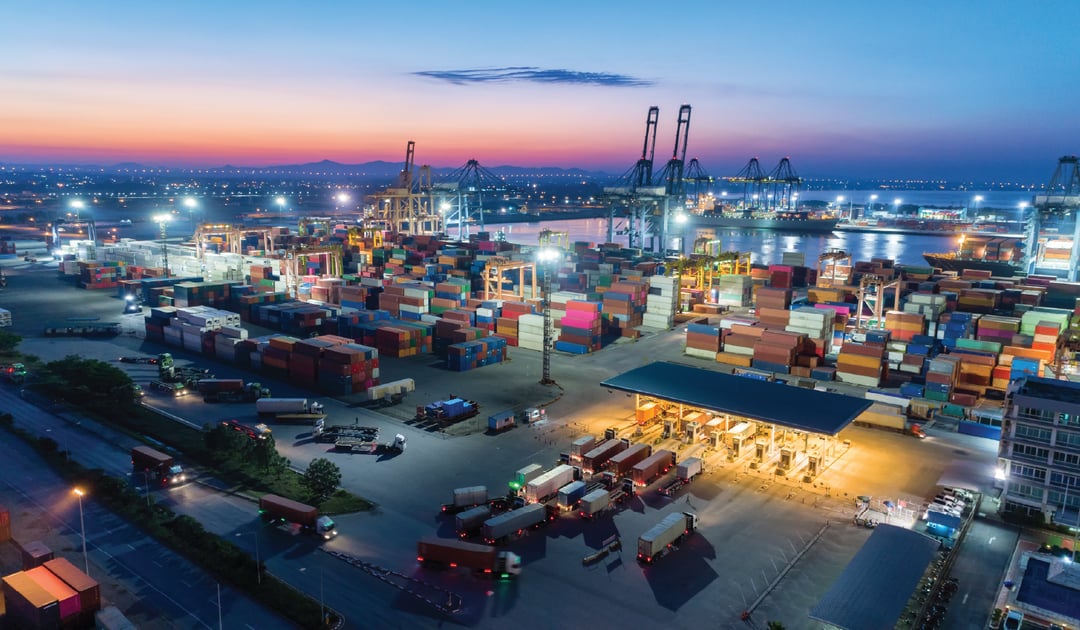
Global supply chains depend on efficiency, cost control, and regulatory compliance. Two of the most powerful tools importers and manufacturers can use to manage tariffs and streamline U.S. logistics are Foreign Trade Zones (FTZs) and bonded warehouses.
Both options allow companies to store imported goods on U.S. soil while deferring, reducing, or in some cases eliminating duty payments. However, understanding the differences between them is critical. FTZs and bonded warehouses operate under distinct regulatory frameworks, offer different operational advantages, and are suited to different business models.
Choosing the right structure can be a game changer by helping companies reduce overall landed costs, avoid unnecessary duty payments, and improve cash flow through smarter tariff strategies. This guide explores FTZs and bonded warehouses in depth, highlights their key differences, and explains how pairing either solution with intermodal logistics can unlock even greater cost savings and supply chain resilience.
Bonded warehouses: Duty deferred
A bonded warehouse is a secure facility authorized by U.S. Customs and Border Protection (CBP) where imported goods can be stored without paying customs duties, taxes, or certain fees until they formally enter U.S. commerce. Duties are assessed only when the goods are withdrawn for domestic consumption.
How bonded warehouses work
When goods arrive from overseas, importers can place them in a bonded warehouse and store them for up to five years without paying duties. During that time, companies can typically inspect, sort, label, or repackage goods under CBP supervision, but manufacturing and most value‑added processing are restricted unless the warehouse has a specific manufacturing‑bonded designation and the product is ultimately exported.
Once the importer decides to sell or use the goods domestically, an entry is filed and duties are paid based on the applicable tariff rate. If the goods are exported to another country or destroyed under customs supervision, no U.S. duties are owed.
Key advantages of bonded warehousing
- Deferred duties and taxes: Duties are paid only when goods leave the warehouse for U.S. sale, aligning cash outflow with actual demand and improving working capital.
- Duty‑free re‑export: Goods exported directly from bond without entering U.S. commerce avoid U.S. duties, which is valuable for regional distribution and trans-shipment strategies.
- Strategic consolidation near ports and rail: Bonded warehouses near ports and intermodal terminals support efficient transloading, repacking, and consolidation for inland distribution.
- Inventory control for uncertain demand: Well‑suited to seasonal products, surplus stock, or goods awaiting market clearance, quality testing, or regulatory approval.
Best use-cases for bonded warehouses
Bonded warehouses are often the best choice when you:
- Import goods for storage, staging, or seasonal release.
- Expect that a meaningful share of volume may be re‑exported.
- Face volatile tariff exposure and want the option to delay entry while policies evolve.
- Need a relatively simple, lower‑complexity structure compared with an FTZ.
Foreign Trade Zones (FTZs): Duty optimization
A Foreign Trade Zone (FTZ) is a special customs area located within or near a U.S. port where foreign and domestic goods are treated for duty purposes as if they are outside U.S. commerce. This allows companies to store, manipulate, assemble, relabel, or even manufacture products before duties are assessed.
How FTZs work
Companies operating in an FTZ can import parts, components, or finished goods, store them, and perform activities such as assembly, kitting, relabeling, testing, and full manufacturing under CBP‑approved procedures. Duty is not paid at admission; instead, the FTZ user chooses how and when duty is assessed when merchandise leaves the zone for U.S. commerce.
Critically, FTZ rules allow several powerful tariff‑optimization levers:
- Inverted tariff benefit: If the finished product has a lower duty rate than its imported components, an FTZ lets you elect to pay duty at the lower finished‑good rate instead of the higher component rates. This is common in industries where parts carry high tariffs but completed equipment is rated lower.
- Tariff classification transformation: When goods undergo qualifying manufacturing or substantial transformation inside the FTZ, their tariff classification can change from the inbound HTS code for parts to the outbound HTS code for the finished product, often moving into a lower duty bracket.
- Duty relief on exports, scrap, and waste: Duties are never paid on goods that are exported directly from the FTZ or destroyed under supervision and can be reduced or eliminated on materials lost to scrap, damage, or obsolescence during production.
- Weekly entry and MPF savings: Approved FTZ users can file a single weekly consumption entry covering all withdrawals, dramatically reducing Merchandise Processing Fee (MPF) and brokerage costs versus paying MPF on every individual shipment.
Together, these tools go far beyond simple duty deferral and enable structural reductions in effective duty and fee burden.
Key advantages of FTZs
- Duty reduction, not just deferral: Pay lower duties on finished products instead of higher component rates via inverted tariffs, and avoid duty entirely on exports and qualified scrap or waste.
- Tariff engineering via in‑zone processing: Use assembly, kitting, or manufacturing inside the FTZ to transform components into finished goods that fall under more favorable HTS classifications and duty rates.
- MPF and fee savings through weekly entry: Consolidate multiple outbound shipments into a single weekly customs entry, capping MPF and reducing administrative and brokerage expenses.
- Elimination or reduction of certain port fees: Depending on how goods are admitted and cleared, FTZ movements can reduce Harbor Maintenance Fee and other port‑related charges compared with standard entries.
- Unlimited storage and flexible inventory management: Goods can remain in an FTZ indefinitely, giving importers maximum flexibility to balance global sourcing, domestic demand, and export opportunities without triggering duty until needed.
- Supports domestic manufacturing: FTZs are ideal for companies blending foreign inputs with U.S. labor and materials in ongoing production or kitting operations, especially in automotive, electronics, and industrial equipment sectors.
Best use-cases for FTZs
FTZs are typically best when you:
- Run continuous manufacturing, assembly, repair, or kitting using imported components.
- Are a high‑volume importer seeking structural tariff optimization and MPF savings across many SKUs.
- Operate near major ports or intermodal hubs and want an integrated production‑and‑distribution campus.
- Perform repairs, testing, or relabeling before domestic sale and want to defer or reduce duties on inbound components.
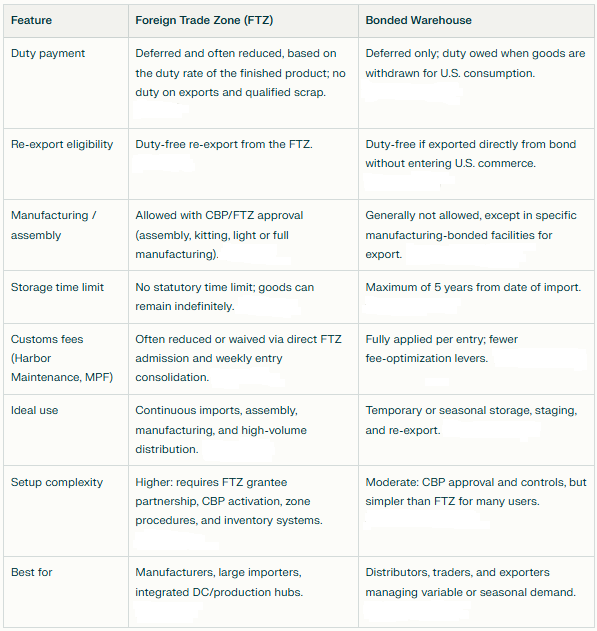
FTZ vs. Bonded Warehouse Comparison
Limits and risks to keep in mind
Bonded warehouse limitations
- Five‑year storage limit: In the U.S., goods can only remain in a bonded warehouse for up to five years from the date of import; after that they must be entered, exported, or may face penalties or seizure.
- Limited manufacturing: Most bonded warehouses do not allow manufacturing for the U.S. market; only certain manufacturing‑bonded sites can produce in bond for export.
- Foreign‑status focus: Domestic‑status goods generally cannot be mixed into bonded inventory, which can complicate operations for some users.
- Storage and handling costs: Duty is deferred, not eliminated. Storage, insurance, and handling costs still apply and must be weighed against the duty savings.
FTZ limitations and risks
- Setup and operating cost: FTZs involve application fees, systems, security, and ongoing compliance work that may not pencil out for low volumes.
- Strict compliance requirements: FTZ operators must maintain detailed inventory control and recordkeeping systems, file regular reports, and pass CBP reviews; non‑compliance can trigger fines or suspension of zone status.
- Location constraints: FTZ use is tied to approved zone sites and operators, so not every facility or market has practical FTZ access.
Types of bonded warehouses (at a glance)
U.S. Customs recognizes multiple classes of bonded warehouses, ranging from public storage to manufacturing sites.
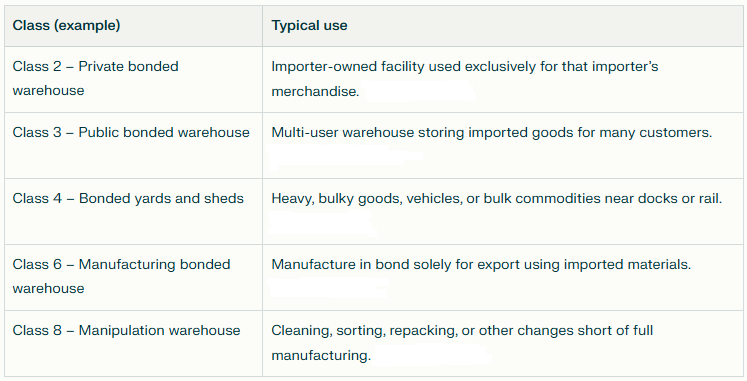
You do not have to choose a class yourself if you partner with an existing provider, but understanding these categories helps clarify what a particular bonded facility is allowed to do.
What it takes to get started: Bonded warehouse & FTZ
Opening a bonded warehouse or setting up a foreign trade zone (FTZ) sounds simple when outlined below, but make no mistake there is quite a bit of work to be done to start, and a great deal of compliance checks and balances must be in place to operate efficiently in compliance with U.S. Customs.
Setting up an FTZ is far more difficult, but used in the correct situation maximizes return.
In both cases, we highly recommend bringing in an expert in the field to help your company through the process. There are a number of third-party logistics companies that do offer the services, so companies do not have to go it alone.
Getting started with a bonded warehouse
- Partner with a customs broker and warehouse provider that holds a CBP bonded license.
- Put procedures in place to track import dates, lot IDs, and five‑year time limits on stored goods.
- Align commercial terms so customers understand when duties will be paid and who is importer of record.
Getting started with an FTZ
- Coordinate with the local FTZ grantee and CBP to identify an appropriate zone site and submit an FTZ application.
- Develop an FTZ operating manual, security plan, and inventory control and recordkeeping system that meet CBP standards.
- Implement FTZ‑compatible software (integrated with ACE/ABI), train staff, and complete CBP activation and site inspection.
These steps are usually done with the help of an FTZ consultant or logistics partner who has implemented zones before.
Why pair FTZs or bonded warehouses with intermodal?
Locating an FTZ or bonded warehouse near a major intermodal hub, such as Los Angeles/Long Beach, Chicago, Dallas–Fort Worth, Atlanta, Kansas City, New York/New Jersey, or Seattle, can turn tariff strategy into a transportation and sustainability advantage.
1. Reduced drayage costs
Intermodal‑connected facilities minimize short‑haul trucking between ports, rail ramps, and warehouses, reducing drayage miles, congestion, and accessorial charges. Import containers can move quickly by rail from the port to inland FTZ or bonded locations for storage, processing, or redistribution.
2. Faster customs clearance and throughput
Co‑locating customs inspection capabilities with FTZ or bonded storage near rail terminals can accelerate cargo flow, reduce terminal dwell, and minimize demurrage and detention. Freight moves off the dock and into the zone quickly, while formal entry and duty payment happen later, when inventory is actually needed.
Often a bonded warehouse is used to transload what would be IPI freight into a domestic intermodal container or truckload to then travel in-bond to another bonded DC or FTZ.
3. Improved inventory flow near demand centers
With intermodal, importers can stage inventory at inland hubs close to customers, without paying duties upfront in the case of FTZs and bonded warehouses. This links global sourcing directly to domestic distribution, supporting multi‑DC replenishment, faster response to regional demand shifts, and better service levels.
Yes, shippers use trucks, but the efficiency brought into the supply chain with intermodal is exponential when positioned at or near a rail intermodal ramp. Also, why not optimize across intermodal and truckload to gain the best of both within your company's logistics strategy? This can only be done when positioned close to an intermodal ramp.
4. Lower carbon footprint
Intermodal rail can cut greenhouse gas emissions 30–60% compared with long‑haul truck‑only moves, especially on dense lanes where rail is fuel‑efficient and terminals are well‑connected. A single intermodal train can replace hundreds of trucks, making FTZ or bonded strategies near rail hubs a strong sustainability lever.
5. Flexibility for re‑exports or domestic entry
Combining FTZ or bonded programs with intermodal creates routing options:
- Move containers inland by rail to zone facilities, then decide whether goods enter U.S. commerce, move to a different region, or are re‑exported with minimal double handling and controlled duty exposure.
- Use different ports or inland ramps as conditions change, while keeping the customs strategy consistent.
This turns customs and tariff planning into a flexible network design tool, not just a compliance requirement.
A simple FTZ vs. bonded feasibility checklist
To decide whether an FTZ, a bonded warehouse, or neither makes sense, start with three questions:
- What share of your imports are components versus finished goods?
- Mostly components flowing into continuous production generally favors an FTZ.
- How much volume is likely to be re‑exported or stored long term?
- High re‑export share or long‑term staging with limited processing can favor bonded warehousing.
- Is your volume high and predictable enough to justify FTZ compliance overhead?
- Larger, steady flows with many SKUs are better candidates for FTZ inverted tariffs and weekly entry savings.
Many shippers ultimately use both tools in different parts of their network, based on product type, volume, and location.
Making the right choice for your supply chain
Deciding between an FTZ and a bonded warehouse ultimately comes down to your import profile, operations, and long‑term strategy.
Choose a bonded warehouse if you:
- Primarily import goods for storage, seasonal sale, or staging before final destination is known.
- Expect a significant portion of your inventory may be re‑exported.
- Need a simpler, quicker‑to‑launch structure to add duty deferral and re‑export flexibility.
Choose an FTZ if you:
- Operate ongoing production, assembly, repair, or customization using imported components.
- Are a high‑volume importer looking for structural duty reduction, MPF savings, and unlimited storage flexibility.
- Want a single hub that integrates manufacturing, distribution, and tariff optimization near ports or intermodal hubs.
Both strategies become significantly more powerful when integrated with intermodal logistics, allowing your company to capture duty efficiency, transportation savings, and sustainability benefits at the same time.
For static, storage‑driven imports with uncertain demand or re‑export potential, bonded warehouses deliver straightforward duty deferral and flexibility to help adapt to supply chain pressures brought on by tariffs. For continuous production, assembly, or complex global sourcing, Foreign Trade Zones provide deeper tariff optimization, unlimited storage, and streamlined customs processes.
In both cases, the winning strategy is to align your customs approach with transportation design—connecting ports, rail, and inland distribution centers through FTZ or bonded programs. Done well, tariff management becomes a driver of landed‑cost reduction, resilience, and competitive advantage rather than a fixed cost burden.
For more about InTek Logistics - and the industry in general, go to our Resources or visit the highlighted pages below. If you're interested in working with us, hit the Talk to Us button and we'll be happy to get in touch to discuss your freight needs.
- Domestic Freight Services: Intermodal, Truckload
- Transloading Services
- Outsourced Managed Transportation Service Solutions