

Truckload• Intermodal Transportation• Logistics & Supply Chain• Logistics Service Provider• Transloading• IPI
For years, inland point intermodal (aka interior point intermodal - both abbreviated as IPI) has been the default inland routing choice for import freight moving beyond the port. It’s simple, familiar, and often bundled directly into ocean contracts.
But today’s freight environment is defined by port congestion, inland rail variability, rising accessorial costs, and demand volatility where simplicity is no longer enough.
More shippers are discovering that transloading at or near the port delivers better control, faster inland movement, and lower total landed cost than IPI. The difference isn’t subtle. It’s structural.
This article breaks down why transloading often outperforms IPI, when IPI still makes sense, and how shippers can use transloading to build faster, more resilient inland supply chains.
What is IPI in intermodal?
IPI refers to the process of moving an international ocean container intact and undisturbed from the port of entry to an inland rail ramp, where it is then drayed to its final destination.
On paper, IPI offers:
- Fewer touches
- A single through bill of lading
- Perceived cost savings when bundled with ocean freight
Historically, this model worked well when ports were fluid, rail networks had excess capacity, and inland demand was predictable.
However, the operating assumptions behind IPI no longer align with today’s reality.
According to the Federal Maritime Commission (FMC), extended dwell times, equipment shortages, and inland congestion have materially increased total landed costs for importers relying on intact container moves inland.
The Hidden Assumptions Behind IPI
IPI requires shippers to make several commitments far earlier than most realize:
- Final inland destination is locked in at the time of ocean booking
- Inland rail service reliability is assumed
- Dwell at port and inland ramps is treated as an acceptable risk
When those assumptions break down, as they frequently do, IPI quickly becomes slower, more expensive, and harder to manage.
What is transloading relating to intermodal?
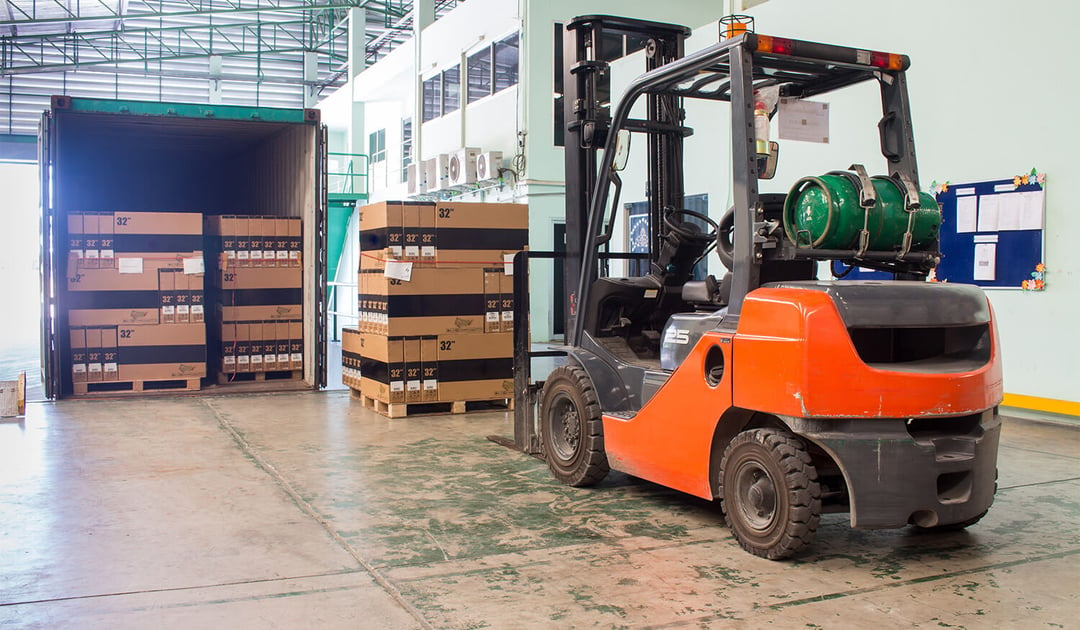
Transloading involves unloading international containers at or near the port and transferring the freight into 53’ domestic equipment for inland transportation via truckload or domestic intermodal rail.
Instead of moving the ocean container inland, the shipper:
- Returns the international container quickly
- Converts freight into domestic capacity
- Gains immediate access to the inland transportation network
Port and terminal operators increasingly describe congestion not as a one‑off disruption, but as a structural challenge driven by high volumes, chassis and truck capacity constraints, and long container dwell times that ripple into higher costs and unreliable schedules for shippers.
Case studies around the LA/LB complex highlight how shifting containers quickly to inland transload hubs shortens port dwell and supports the ports’ broader goals of higher throughput and fewer trucks queuing at terminals.
Port-Centric Transloading Explained
Transloading near the port allows shippers to:
- Eliminate long port dwell
- Reduce demurrage, detention, and chassis charges
- Move freight inland on predictable schedules
- Optimize load configurations using 53’ domestic equipment
For shippers moving freight 700+ miles inland, this structural advantage matters.
Control Sooner: Why Transloading Wins
The most overlooked advantage of transloading is when control shifts back to the shipper.
With IPI, control is largely ceded to:
- Ocean carrier schedules
- Rail ramp congestion
- Fixed inland routing decisions made weeks earlier
With transloading, control returns immediately upon vessel discharge.
Shippers can:
- Decide inland mode after arrival
- Re-route freight based on real-time demand
- Split inventory across multiple distribution centers
- Respond to market changes without rebooking ocean freight
This demand-driven flexibility is increasingly critical as inventory strategies evolve away from rigid, forecast-based models.
Inventory Control and Network Flexibility
Transloading enables:
- Multi-DC replenishment from a single import flow
- Dynamic allocation during peak seasons
- Faster response to regional demand shifts
- Reduced risk of overstocking the “wrong” location
Industry case studies show that port‑proximate transloading and regional warehousing improve resilience by positioning inventory closer to key markets, cutting lead times, and supporting faster redeployment when demand or routes change. Providers also highlight transloading as a core resilience tool, allowing shippers to bypass bottlenecks, pivot between modes, and maintain service levels through disruptions while optimizing inventory and storage across multiple nodes.
Speed and Reliability: Transload vs. IPI
IPI transit times are often longer and far less predictable than advertised. Why?
- Containers wait at the port for rail availability
- Trains dwell in congested yards
- Inland ramps experience bottlenecks
- Switching delays add days, not hours
By contrast, transloading creates a faster first mile, which almost always results in faster total transit.
Faster First Mile = Faster Total Transit
When freight is transloaded:
- Containers are unloaded immediately
- International equipment is returned quickly
- Domestic moves depart on scheduled capacity
- Inland transit windows become more predictable
The Journal of Commerce has repeatedly documented that transloaded cargo often reaches inland destinations days ahead of intact IPI moves during congestion cycles. The latest came during the annual JOC Inland Conference where Brian Kempisty, founder of Port X Logistics, spoke on the merits of transloading vs IPI. The Intermodal Logistics Podcast had Brian on to discuss more specifics.
Cost Transparency and Accessorial Reduction
IPI is often sold as “cheaper,” but that claim rarely survives a full landed-cost analysis. Common IPI cost drivers include:
- Demurrage
- Detention
- Chassis rental
- Port storage fees
- Long dwell penalties
- Missed delivery appointments inland
These costs are volatile, difficult to forecast, and frequently appear after the fact.
Why “Cheaper on Paper” Isn’t Cheaper in Reality
Transloading reduces exposure to these costs by:
- Returning containers quickly
- Eliminating long chassis usage
- Shortening port dwell
- Converting unpredictable fees into fixed inland pricing
Shippers gain cost certainty, not just theoretical savings. Freight companies have highlighted how accessorial volatility, not linehaul, has become the largest source of import cost overruns.
Domestic Intermodal Performs Better After Transload
Domestic intermodal rail is optimized for:
- 53’ equipment
- Scheduled ramp-to-ramp service
- Consistent volumes
- Clean network handoffs
Domestic intermodal is built on service that more closely aligns with truckload as its direct competition. International IPI moves often clash with these operating realities.
Transload as the Bridge Between Ocean and Domestic Rail
By converting freight into domestic equipment at the port, shippers:
- Improve intermodal service reliability
- Expand available inland lane options
- Reduce exposure to international container imbalances
Industry data from the Intermodal Association of North America (IANA) distinguishes domestic and international intermodal as separate segments, while industry studies note that IPI services are typically less frequent and slower than domestic‑box services, which can create more volatility in transit times.
Risk Management and Supply Chain Resilience
IPI creates a single point of failure:
- One container
- One inland route
- One ramp
- One rail service path
When disruption occurs, recovery options are limited.
Why Transloading Reduces Single-Point-of-Failure Risk
Transloading introduces:
- Multiple inland routing options
- Mode flexibility (truckload or intermodal)
- Faster recovery from port or rail disruptions
This optionality is increasingly valuable as labor issues, weather events, and infrastructure constraints continue to affect freight networks.
Major rail industry groups, including the Association of American Railroads (AAR), highlight the role of intermodal investments and rail–truck integration in creating more flexible and resilient freight networks, even if they do not single out transloading by name.
When IPI Still Makes Sense
IPI can still be appropriate when:
- Freight has a single, fixed inland destination
- Value density is low
- Transit time variability is acceptable
- Inland distance is relatively short
- Simplicity outweighs flexibility
In other words, transloading isn’t a universal answer, but it is often the better strategic choice.
When Transloading Is the Better Choice
Transloading typically wins when shippers:
- Serve multiple regions
- Move time-sensitive or seasonal goods
- Face high port dwell risk
- Want inland routing flexibility
- Prioritize control and predictability
For many importers, that describes their network today.
How InTek Logistics Helps Shippers Optimize Transload Strategies
At InTek Logistics, we help shippers:
- Evaluate IPI vs. transload landed cost scenarios
- Design port-centric transload strategies
- Integrate domestic intermodal for long-haul efficiency
- Improve visibility from port to final delivery
- Reduce accessorial risk and transit variability
Our role isn’t to push a mode it’s to optimize outcomes.
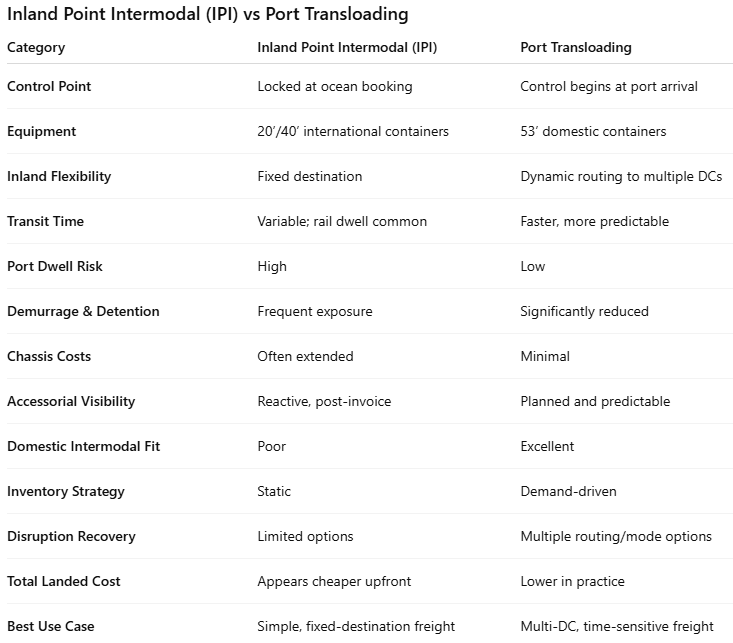
Graphic Summary of IPI vs Transloading to 53' Equipment
Control, Speed, and Optionality Win
IPI is convenient, but rigid.
Transloading restores control sooner, improves speed, reduces risk, and delivers true cost transparency. In a freight environment where variability is the norm, flexibility beats simplicity every time.
For shippers looking to move faster, manage risk, and stay competitive, transloading isn’t just an alternative, it’s a strategic advantage.
Thinking about moving away from IPI? Let InTek Logistics model your IPI vs. transload landed cost and show you where control, speed, and savings can improve.
For more about InTek Logistics - and the industry in general, go to our Resources or visit the highlighted pages below. If you're interested in working with us, hit the Talk to Us button and we'll be happy to get in touch to discuss your freight needs.
- Domestic Freight Services: Intermodal, Truckload
- Transloading Services
- Outsourced Managed Transportation Service Solutions