


The truckload marketplace is a highly fragmented market with 700,000 motor carrier companies, with 91.0% operating 6 or fewer trucks and 97.3% operating fewer than 20 trucks.
Conversely, 53' domestic intermodal has a handful of majors, with maybe another 25 to 30 "real" contenders operating in the 53' domestic intermodal space.
Understanding who the intermodal contenders are and how a shipper can tap into 100% of the available capacity is key to successfully optimize intermodal within your logistics and supply chain strategies.
To continue, not all IMC's (intermodal marketing companies) have the ability to access the entire fleet of 53 'containers. Also, not all IMC's tap into the ISO re-positioning market for additional capacity found with 20' and 40' ISO containers, which is in addition to the container fleets listed below.
The key to unlocking the treasure chest of intermodal capacity starts with the following two charts on private and public owners of intermodal containers:
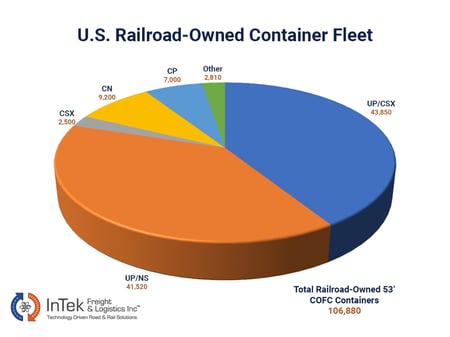
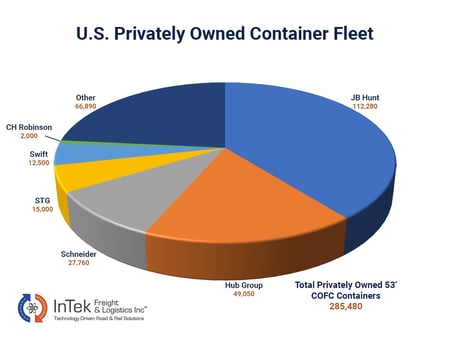
The total number of domestic private and rail-owned 53' dry intermodal containers currently stands at 392,360. The BNSF railroad does not own containers, making this railroad essentially the private box owner railroad. JB Hunt primarily operates on the BNSF network, while , Schneider Swift operate on the Union Pacific rail system. This also makes it easier for shippers to identify with these brands and access their capacity, as demonstrated in the article The Best Intermodal Companies (And How To Choose).
The Union Pacific, Norfolk Southern and CSX own containers that move across all three networks through either steel wheel or rubber tire interchanges between the different railroad intermodal ramps to traverse North America. These railroads own their own boxes in the EMP and UMAX containers, but they also run the Hub and XPO private owned containers.
The importance of understanding the box ownership and the railroad network the boxes operate within answers the questions of capacity, pricing and transit. There are a number of examples on all three topics, but for the brevity of this blog will share just a couple.

Starting with the private ownership chart, it is easy to identify the list of intermodal service providers. To access the full complement of 53' containers shippers need to explore other options through the Railroad Fleet chart. The difficulty is transparency on the providers available through the various railroads because they do not sell retail, meaning they do not sell direct to shippers. Therefore, shippers access the UP, NS and CSX boxes through an IMC that represents the major intermodal railroads.
Companies, such as InTek Logistics, are non-asset IMCs that access all boxes under the Total Box Fleet chart through their direct relationships with the railroads, private box IMCs and ISO box alliances. There are a number of similar IMCs. Many times the major intermodal railroads will recommend and introduce a shipper to an IMC when contacted.
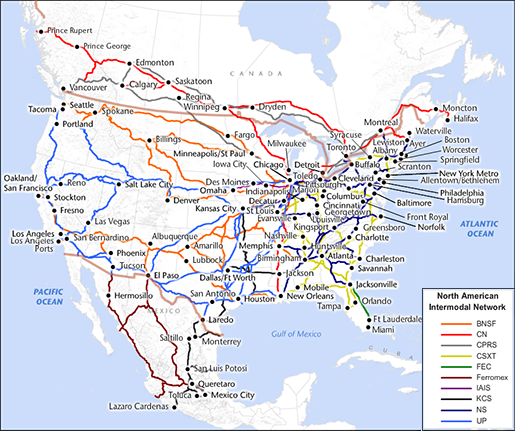
Shippers should evaluate all available intermodal options because railroad networks and ramp locations vary. Not every railroad operates an intermodal ramp in every market, so the best railroad and routing will depend on the shipment’s origin, destination, service requirements, and total door-to-door cost.
When only one railroad operates an intermodal ramp in a market, it may have a significant drayage advantage for freight originating or terminating there. Using another railroad’s network could require a longer dray, increasing cost, transit time, and service risk.
Ramp selection also matters in markets served by multiple facilities. Chicago, for example, has several intermodal ramps spread across a highly congested metropolitan area. Shippers should understand which ramp their intermodal marketing company, or IMC, is recommending and confirm that it provides the best combination of drayage cost, rail price, and service.
Rail routing can also affect service reliability. During the Los Angeles wildfires, the railroads serving the market used different routes into and out of the region. One railroad was able to continue operating, while another suspended service because the fires threatened its tracks.
The lowest quoted rate is not always the best option. The railroad, ramp, routing, and drayage plan must all fit the shipper’s specific freight requirements.
Again, there are several other examples, so do the homework and be sure to include intermodal marketing companies (IMCs) that can support all networks or bring in multiple IMCs that support specific networks to ensure best transit, value and diversification.
For more on information on the topic of 53' domestic intermodal, truckload and managed transportation services, please sign up for our blog.
Also, below are additional blogs to explore further detail on intermodal topics discussed above:
- What is an Intermodal Marketing Company
- Cost of Intermodal Transportation Services (Rates, Fees & Variables)
- Defining Asset & Non-Asset Intermodal Providers - Advantages of Both
- The Secret Behind the "Asset" Based Intermodal Providers
For more on the intermodal industry, we would recommend the Intermodal Association of North America (IANA) website.