


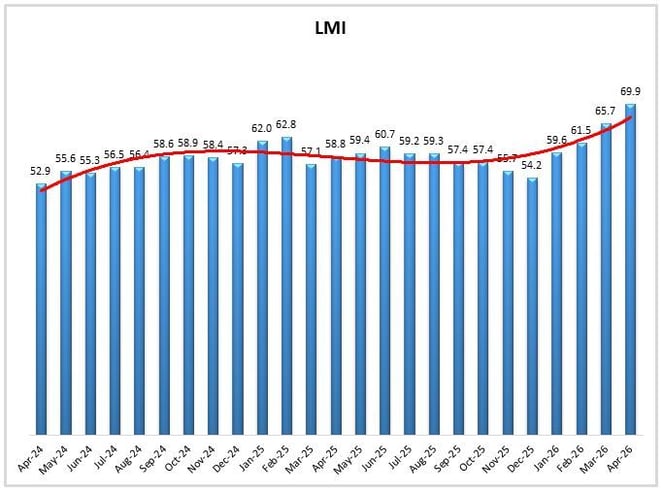
In March, the story was the Logistics Managers' Index (LMI) being near a four-year record. April's LMI has set the new mark, with an overall reading of 69.9, 4.2 points above the month prior and the highest since the third month of 2022. It's also the fourth month in a row the LMI has risen. And the expansion continues to be fueled by freight - specifically freight rates.
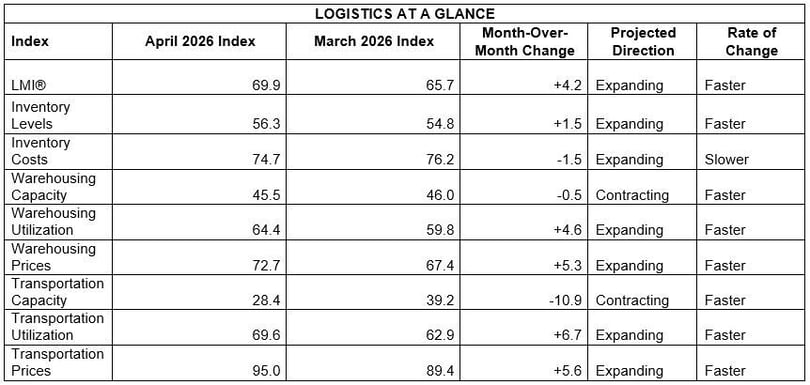
Transportation Prices are growing at an unprecedented clip in the LMI's 10-year history, coming in at an April reading of 95 (+5.6 monthly). Also unprecedented is the gap between prices and Transportation Capacity, which plummeted another 10.9 points monthly to the deeply in contraction reading of 28.4. That marks a gap of 66.6 points, which is easily the largest gulf between those figures the index has ever measured. Transportation Utilization followed prices up, with a 6.7 point gain to 69.6.
So that means we're in a freight boom right...right? It's certainly good for those who move cargo right now, but there are questions of whether the high costs and low capacity (while still missing some volume support) are sustainable as the year goes on.
But going back to the "for now," there is enough movement to support carriers and brokers with the more just-in-time inventory posture of today. Inventory Levels saw a minor increase of 1.5 to 56.3 last month, suggesting perhaps a bit of stock-up to avoid moving as much as rates continue rising. Inventory Costs, incidentally, ticked down 1.5 to 74.7.
Warehousing Prices on the other hand, were up 5.3 to 72.7, and Warehousing Utilization followed suit, rising 4.6 to 64.4. Lagging behind was Warehousing Capacity, which only fell 0.5 to 45.5.
Again, the broader economy bears watching to determine whether these are the early stages of a boom period for freight, or if outside factors like the Iran attacks (with the corresponding soaring gas prices) and the continued effects of tariff policy lead to inflation blunting demand.
Looking ahead, respondents are optimistic that things are sustainable, with a year-from-now LMI prediction of 73.2 (+5.4 from the March 2027 prediction and 3.3 above where the index sits today). Pros expect Transportation Prices and Capacity to essentially maintain their current stance, while Inventory Levels and Warehousing Utilization rise.
By the Numbers
See the summary of the April 2026 Logistics Managers' Index, by the numbers:
About the Logistics Managers' Index (LMI)
Researchers at Arizona State University, Colorado State University, Rochester Institute of Technology, Rutgers University, and the University of Nevada, Reno - in conjunction with the Council of Supply Chain Management Professionals (CSCMP) - issue the report. The LMI score is a combination of eight unique components that make up the logistics industry, including: inventory levels and costs, warehousing capacity, utilization, and prices, and transportation capacity, utilization, and prices.
The LMI is calculated using a diffusion index, in which any reading above 50.0 indicates that logistics is expanding; a reading below 50.0 is indicative of a shrinking logistics industry. The latest results of the LMI summarize the responses of supply chain professionals collected in April 2026. Learn more about the index on our podcast with its primary author Zac Rogers, Ph.D., associate professor of Supply Chain Management at Colorado State University.
Need assistance with your shipping operations? Request a quote with us, and we'll get back to you to discuss your unique needs. Go to our Freight Guides to learn more about everything freight and logistics. Additionally, visit our blog for information and updates on the freight industry.