
![]()
InTek Intermodal Index (III) Week Ending Sept. 21, 2026

Weekly market intelligence including the InTek Intermodal Index (tracking intermodal spot rates), along with truckload pricing, diesel trends, and railroad volumes - Historical Edition
This Week at a Glance
Week ending September 21, 2026
Intermodal Spot Rate
(excluding fuel)
▲ +1.3% vs. last week
▲ +6.6% vs. last year

Truckload Spot Rate
(excluding fuel, DAT)
▲ +0.3% vs. last week
▲ +42.4% vs. last year

Diesel Fuel
(EIA National Average)
▲ +3.9% vs. last week
▲ +74.2% vs. last year

Intermodal Volume
(YTD vs. 2025)
U.S. ▲ +3.9%
North American ▲ +3.2%

This Week's Analysis
By Rick LaGore, CEO, InTek Logistics | September 21, 2026
Analysis of the InTek Intermodal Index (III) and freight market trends
Trends in the Intermodal Transportation Spot Rate and Market
Intermodal spot climbed again, diesel pushed past $6.50, and truckload held about flat. Intermodal spot rose 1.3% and stands 6.6% above 2025, another new year-to-year high. Truckload spot edged up 0.3%. Diesel jumped 24.4 cents to $6.529, now 74.2% above last year. Volume firmed a tenth, with US intermodal at 3.9%.
Intermodal has now put together four gains in five weeks. The annual reading has climbed from the low 4s to 6.6% over that stretch. The single flat week in the middle looks like the pause it was. This is the durability the run kept getting asked about.
The demand picture underneath isn't moving. Volume firmed a tenth, which is steady rather than the seasonal surge that peak pricing would imply. Both modes sit well above last year on the annual read. The freight is carried by conversion and cross-border instead of a broad demand lift, and that gap between rising prices and flat volume held again this week.
The linehaul spread widened in intermodal's favor for a second straight week. The bigger mover is still fuel. Diesel at $6.529 with a 74% year-over-year gap widens intermodal's cost advantage regardless of what the linehaul rates do week to week.
For shippers who read this regularly, you'll note this last paragraph is staying remarkably similar. But that's because the market is sending a consistent signal: Price the spread on total landed cost with fuel in it.
The fuel line is the largest single item in the comparison, and where diesel goes next depends on refining margins more than on crude. As usual, watch the 3-2-1 crack spread.
InTek Intermodal Index (excluding fuel):
- Up 1.3% vs. prior week
- Up 6.6% vs. prior year
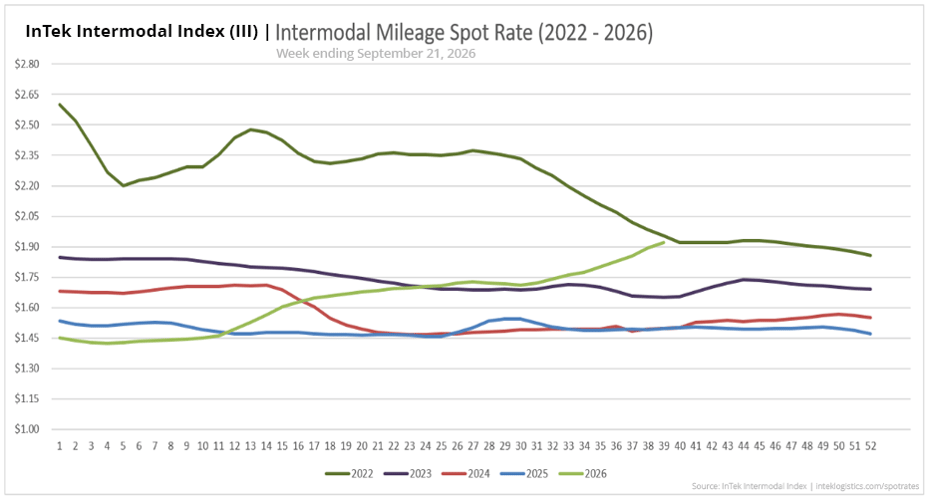
The InTek Intermodal Index (III), which tracks intermodal spot rates, rose 1.3% for the week and stands 6.6% above 2025 - the firmest annual reading of the year.
The weekly gains have been steady and additive, without one single spike, which is what gives the climb its durability. At 6.6%, intermodal's cost base is now well above where it sat a year ago, and the trend has held through peak instead of fading into it.
National Truckload Spot Rate (DAT, excluding fuel): (DAT Trendline Report)
- Up 0.3% vs. prior week
- Up 42.4% vs. prior year
Truckload spot edged up 0.3% for the week and holds 42.4% above last year. The move is small enough to read as flat, so intermodal firming while truckload held steady tightened the linehaul spread back (slightly) toward intermodal again.
The premium to intermodal stays large, and truckload above 40% year over year keeps the mode gap wide on lanes where both compete. Peak (such as it is) is holding truckload up, but the overall demand read underneath is still soft.
Diesel Fuel (EIA):
- $6.529/gallon
- Up $0.244 (3.9%) vs. prior week
- Up $2.780 (74.2%) vs. prior year
Diesel cleared another unfortunate milestone, setting yet another high at $6.529 per gallon, up 24.4 cents (3.9%) on the week and $2.78 (74.2%) on the year.
This is the third consecutive weekly jump, and the year-over-year gap widened again to its steepest of the run.
The driver continues primarily to sit in refining and distillate supply, not in crude. For a shipper, the 3-2-1 crack spread, not the crude price, is what to watch for where diesel goes next. And keep in mind, rail is roughly three times more fuel efficient than over-the-road truck on a ton-mile basis. At a 74% year-over-year diesel gap, that efficiency widens the intermodal cost advantage further and keeps marginal long-haul freight converting to rail.
(The full spreadsheet of the historical weekly price moves of diesel full can be found at https://www.eia.gov/petroleum/gasdiesel.)
Year-to-Date Intermodal Volume by Region and Railroad vs. 2025
North American intermodal volume runs 3.2% ahead of 2025 year to date and US volume 3.9%, both firming a tenth from last week. The move is small, which is the point. Peak is showing in the rates and not in a volume surge, keeping this a conversion-and-cross-border market rather than a demand-driven one.
On the reported table, GMXT leads at 13.6%, holding well ahead of the group. CSX (5.5%) and BNSF (5.0%) run above the US average, with NS (3.9%) at the average. UP firmed to 1.0% and CPKC to 1.3%, both extending the ground they gained over the summer. CN at -2.6% remains the lone holdout below last year. The spread from strongest to weakest stays wide, and it still traces mostly to the Mexico-versus-Canada cross-border difference.
North American Intermodal
3.2%
U.S. Intermodal
3.9%
Volume by Railroad
| BNSF | 5% |
| CN | -2.6% |
| CPKC | 1.3% |
| CSX | 5.5% |
| GMXT | 13.6% |
| NS | 3.9% |
| UP | 1% |
Intermodal Spot Rate Trend Charts
Intermodal Spot Rate Per Mile (Including Fuel)
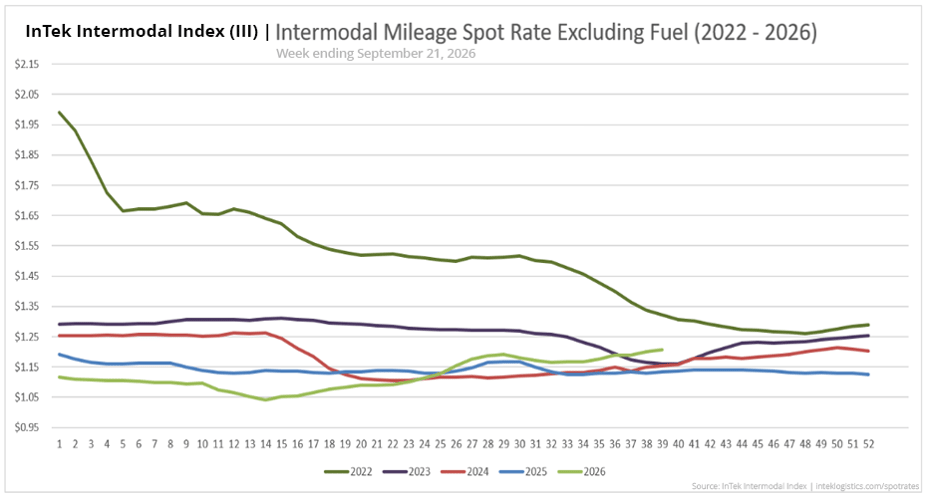
Intermodal Spot Rate Per Mile (Excluding Fuel)
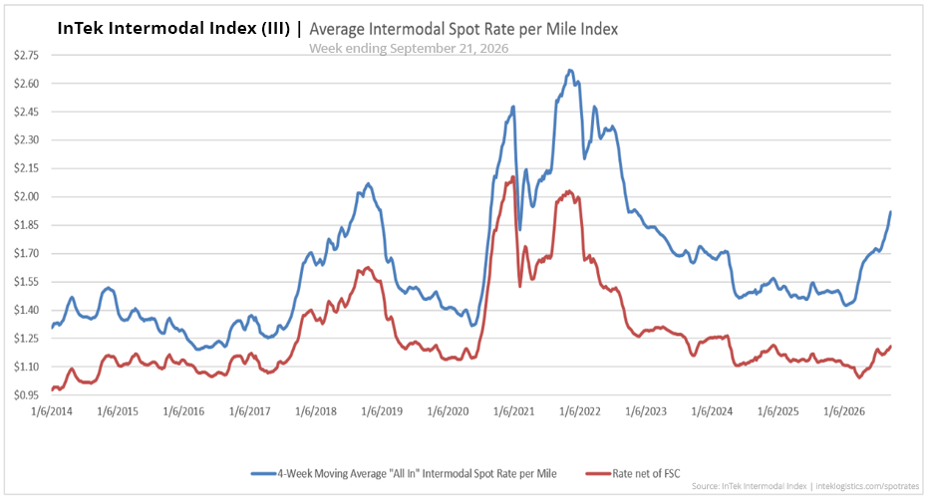
Intermodal Spot Rate Average Per Mile (2014-2026)
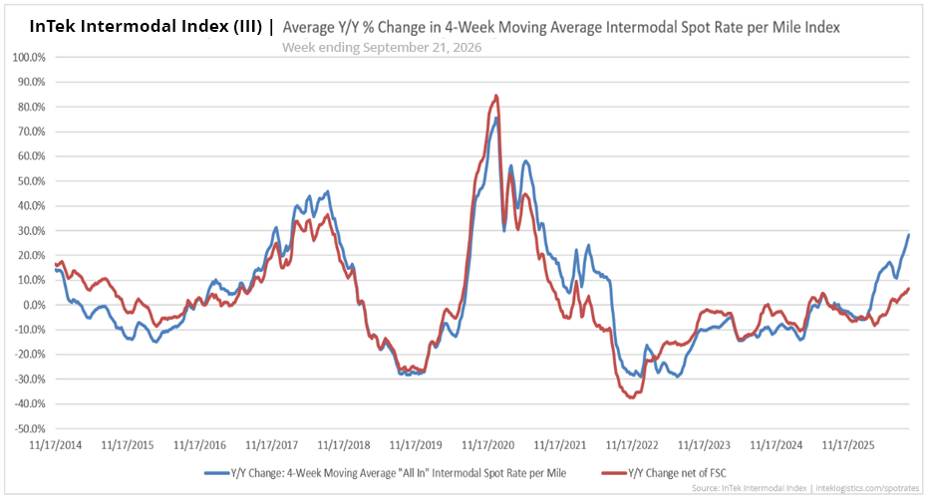
Intermodal Spot Rate Y/Y % Change (2014-2026)

What to watch next week
Three things to watch heading into the week of September 21, 2026.
How long does the intermodal climb run?
Four gains in five weeks have carried year-over-year to 6.6%. Watch whether the run extends or levels as peak crests. A climb this steady tends to slow before it reverses, so a flat week ahead would read as a pause instead of a turn.

Where does diesel stop?
Diesel is up three straight weeks and 74% above last year with no refining relief in sight. Watch the next EIA print and the crack spread. Every week fuel climbs, the intermodal advantage widens and truckload fuel exposure gets heavier heading into fourth-quarter budgets. While it's been quiet so far, hurricane season is still open.

Does volume stay flat while prices climb?
Rates keep rising while volume moves a tenth at a time. Watch whether the freight finally lifts with a late-peak push or whether this stays a pricing market without the volume underneath it.

Last week's scorecard
Last week we flagged three things. Here is how they played out.
-
Does intermodal spot keep climbing? It did. Spot rose another 1.3% and pushed year-over-year to 6.6%, a fourth gain in five weeks. The climb that resumed after the flat print is still building rather than cresting.
-
How far does diesel run past $6? Pretty doggone far. Diesel added 24.4 cents to $6.529, a third straight weekly climb, and the year-over-year gap widened to 74%. The $6 line is well behind now, and the run shows no sign of breaking.
-
Does volume catch up to the pricing? Still no. Volume firmed a tenth while both spot rates held or climbed. The rates keep pricing a tighter peak while the freight underneath moves in tenths, which keeps this a conversion-and-cross-border market rather than a demand-driven one.
About the InTek Intermodal Index:
The InTek Intermodal Index (III) tracks weekly domestic intermodal spot rates on a per-mile basis, both including and excluding fuel surcharges. Each week's report includes comprehensive market analysis covering truckload pricing trends, diesel fuel costs, and railroad intermodal volumes to provide context for rate movements.
With rates tracked weekly since 2008, the Index serves as a resource for shippers, carriers, and industry analysts tracking North American freight market trends.
Citation: InTek Intermodal Index. (2026). Weekly Intermodal Spot Rate Report. Retrieved from https://www.inteklogistics.com/spot-rates
Want custom pricing for your lanes?
Get a tailored intermodal quote based on your specific shipping needs and freight profile.