

Truckload• Intermodal Transportation• Logistics & Supply Chain• Freight Broker• Logistics Service Provider• Freight Forwarder
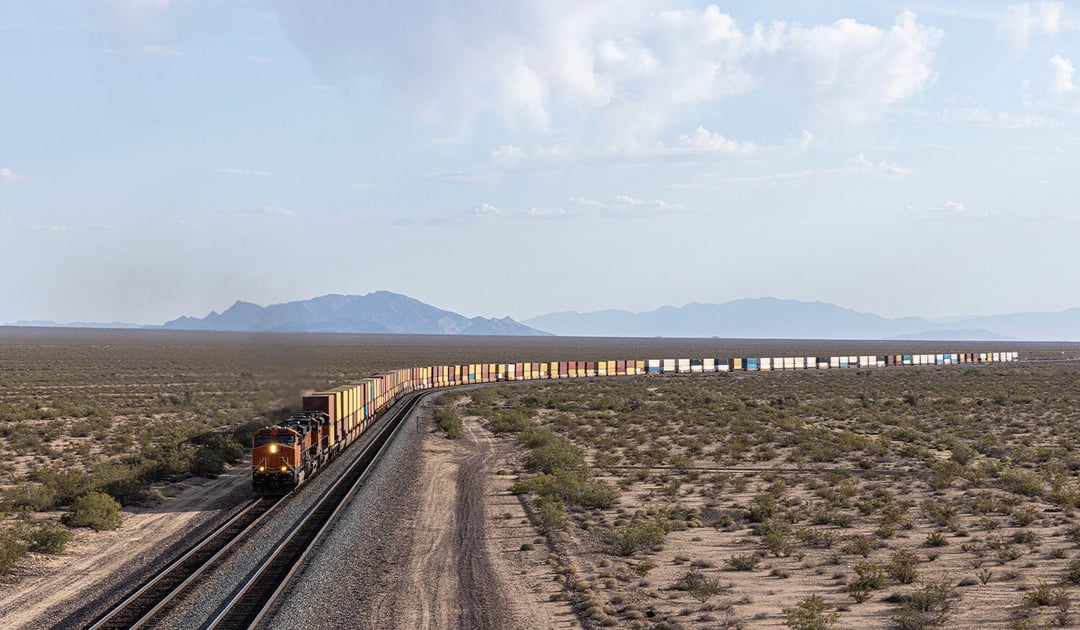
Intermodal transportation combines rail and truck to move freight across North America. Rail handles the long-haul portion. Trucks handle pickup and delivery. The freight stays in the same container throughout - and that's just one of many benefits that make intermodal matter to businesses that use it already and are looking into it.
How about a few more intermodal benefits (which we'll dig deeper on shortly): on the right lanes, intermodal delivers an average of 15% cost savings versus truckload, cuts your carbon footprint by 75%, and provides capacity that doesn't disappear when the truck market tightens.
Those aren't theoretical benefits. They're measurable outcomes that show up on your P&L and in your sustainability reports.
This article breaks down the real benefits of intermodal shipping, explains when those benefits apply, and is honest about when they don't. Because not every lane is an intermodal lane. Knowing the difference is what separates smart freight strategies from expensive mistakes.
The 10 Core Benefits of Intermodal Transportation
1. Cost Savings Averages 15% on Long-Haul Lanes
The most compelling reason shippers use intermodal is cost. On lanes over 750 miles with good terminal access, intermodal typically saves an average of 15% compared to truckload.
Where does the savings come from? Rail economics.
A BNSF double-stack intermodal train is the equivalent of taking 280 trucks off the highway. That efficiency translates into lower cost per ton-mile. Rail can move one ton of freight 450 miles on a single gallon of fuel. Trucks need about four gallons to do the same work.
The savings persist across market cycles. Even during the freight recession that began in July 2022, when truckload rates dropped to near-historic lows, intermodal maintained its cost advantage on appropriate lanes. The gap compressed, but it never closed.
For a deeper look at how intermodal and truckload costs actually compare, read our guide on Intermodal vs. Truckload: A True Apples-to-Apples Cost Comparison.
2. Sustainability and Lower Carbon Emissions
Intermodal is approximately four times more fuel-efficient than truckload shipping. That efficiency translates directly into emissions reduction.
A shipper moving freight via intermodal instead of truck on a 1,500-mile lane reduces carbon emissions by roughly 75% for that shipment. Multiply that across a year of freight moves, and the impact becomes material for corporate sustainability reporting.
This matters beyond the environmental argument. Customers, investors, and boards increasingly require emissions data. Retailers like Walmart and Target include supply chain emissions in their sustainability scorecards. Being able to demonstrate lower-carbon freight choices creates competitive advantage.
Shippers looking to meet SmartWay certification requirements find intermodal an effective tool. The EPA's SmartWay program recognizes the emissions benefits of rail-based freight, making intermodal a straightforward path to certification.
3. Capacity That Doesn't Disappear When Markets Tighten
Freight markets are cyclical. When capacity tightens, truckload rates spike and trucks become hard to find. Shippers who relied exclusively on truckload during soft markets suddenly find themselves scrambling.
Intermodal provides a different capacity pool. Rail capacity is more stable across market cycles. The equipment exists. The trains run on schedule. When truckload capacity evaporates, intermodal remains available.
We saw this play out dramatically in 2020-2021. Shippers who had abandoned intermodal during the soft 2019 market scrambled to get back on rail when capacity tightened. Many found equipment unavailable or faced higher rates than if they'd maintained their programs.
The lesson: intermodal capacity is most valuable when you build it before you need it. Establishing relationships, testing lanes, and proving out service during soft markets positions you to benefit when conditions change.
4. Network Diversification and Risk Reduction
Relying on a single mode creates concentration risk. When that mode experiences disruption, your entire network feels the impact.
Intermodal provides modal diversification. Rail networks operate independently of highway conditions. A major highway closure, a regional driver shortage, or a weather event affecting trucking routes may not affect your intermodal lanes at all.
This doesn't mean intermodal is immune to disruption. Rail has its own vulnerabilities: terminal congestion, train delays, weather affecting specific corridors. But those vulnerabilities are different from truck vulnerabilities. Having both options means you're less exposed to any single point of failure.
Smart shippers use intermodal and truckload together, allocating freight based on lane characteristics and building redundancy into their networks (the best IMCs can do that for them, too).
5. Improved Security for High-Value Freight
Cargo theft isn't just a problem, it's a national crisis - and intermodal can help.
The security profile of intermodal differs significantly from over-the-road trucking.
During the rail portion of an intermodal move, the container is loaded on a wellcar and the train doesn't stop. There's no truck stop parking lot exposure, no overnight rests at unsecured locations, no driver leaving the vehicle unattended.
The bottom container on a double-stacked wellcar can't even have its doors opened while in transit. The physics make it impossible.
Intermodal ramps are secured facilities with controlled access. Between origin pickup and destination delivery, the freight spends the majority of its journey behind secured perimeters or in motion on rail.
In addition to the physics, intermodal requires dray providers to have a UIIA agreement in place in order to move intermodal containers. The UIIA (Uniform Intermodal Interchange and Facilities Access Agreement) is the standardized legal framework that governs how equipment is interchanged between railroads, ocean carriers, equipment providers, and drayage companies.
This agreement is not optional. Without an active UIIA, a dray carrier cannot legally pick up or return intermodal equipment at a rail ramp or marine terminal.
The UIIA governs:
- Liability for container and chassis damage
- Insurance requirements and minimum coverage levels
- Indemnification and responsibility in the event of loss or cargo damage
- Safety and operating rules at terminals and rail facilities
The agreement is administered by the Intermodal Association of North America (IANA) and must be renewed annually. Each year, drayage providers must re-certify their insurance, update company information, and remain in good standing to maintain access to intermodal facilities.
This requirement creates a structural barrier to entry that does not exist in over-the-road trucking. Not every trucking company is eligible or willing to operate under the UIIA due to:
- Higher insurance thresholds
- Tighter compliance oversight
- Greater exposure to equipment liability
As a result, the pool of qualified dray carriers is smaller, more specialized, and more regulated than the general truckload market. For shippers, this is one of the reasons intermodal service reliability depends heavily on working with providers who understand drayage compliance and actively manage UIIA participation, rather than assuming any local trucker can perform the move.
All said, for shippers moving high-value goods concerned about cargo theft, intermodal's security profile represents a meaningful benefit.
6. Consistent Pricing Through Market Volatility
Truckload spot rates can swing dramatically. We've seen 50%+ moves in spot rates during market transitions. That volatility makes budgeting difficult and creates tension between transportation and finance teams.
Intermodal pricing tends to be more stable. Contract rates adjust more gradually. Spot rates, while they move with the market, don't experience the same violent swings as truckload.
This stability comes from intermodal's structure. Rail capacity can't expand or contract as quickly as truck capacity. New drivers can enter the trucking market relatively easily. Building new trains, track, and terminals takes years. That structural stability translates into pricing predictability.
For shippers who need to forecast transportation costs reliably, intermodal's steadier pricing provides budget certainty that truckload often can't match.
7. Operational Advantages for Appointed Deliveries
Here's a benefit that often surprises shippers new to intermodal: it can actually improve on-time delivery performance for retail appointments. How? Transit padding without additional cost.
When shipping to a big-box retailer with strict delivery appointments, truckload transit must be timed precisely. Arrive early, and you wait without compensation. Arrive late, and you face penalties.
Intermodal allows shippers to route freight to arrive at the destination ramp a day or two before the delivery appointment. The container sits at the ramp at no additional charge until it's time for final delivery. The destination dray is typically less than 50 miles, making the final delivery highly controllable.
This approach turns the "extra day" of intermodal transit from a disadvantage into an advantage for appointment-driven freight.
8. Drayage Efficiency and Driver Productivity
Intermodal drayage operates differently than long-haul trucking. Dray drivers work short distances, typically 75 miles or less from the terminal. They can turn multiple loads per day.
This efficiency has implications for capacity. A single dray driver serving an intermodal ramp can handle more shipments per day than a long-haul driver making one delivery over multiple days.
When capacity tightens, this efficiency becomes valuable. The same driver pool can service more freight through intermodal than through truckload. Shippers who use intermodal effectively need less total truck capacity to move the same volume.
9. Cross-Border Shipping Advantages
Moving freight between the U.S., Canada, and Mexico involves customs, duties, and clearance processes that can create delays and complications.
Intermodal often handles cross-border moves more smoothly than truckload. The container seals remain intact throughout the journey. Documentation processes are standardized. Customs inspections, when required, occur at established rail crossings with predictable procedures.
For U.S.-Mexico freight in particular, intermodal provides additional security benefits in regions where cargo theft concerns affect trucking operations.
10. Scalability for Growing Freight Programs
As freight volumes grow, adding intermodal capacity is often easier than adding equivalent truckload capacity. Intermodal scaling leverages existing infrastructure. The trains run whether you ship one container or one hundred. Adding volume to a working intermodal lane doesn't require proportionally more resources.
On the other hand, truckload scaling requires more trucks, more drivers, more carrier relationships. Each additional lane needs its own capacity solution.
For shippers experiencing growth, intermodal provides a scalable foundation that can absorb volume increases without proportionally scaling operational complexity.
When Intermodal Benefits Apply (And When They Don't)
Every intermodal benefit does come with conditions, as the mode doesn't work for every lane or every shipment. Knowing when it works and when it doesn't is essential for building a freight strategy that actually delivers results.
Intermodal Works Best When:
Distance exceeds 750 miles. This is the threshold where rail economics begin to outweigh the added handling. The longer the haul, the stronger the case for intermodal. Lanes over 1,000 miles are often ideal.
Both origin and destination have good terminal access. Dray distances of 75 miles or less on each end keep total landed cost competitive. Long drays erode the rail savings.
Transit flexibility exists. Intermodal typically adds 1-2 days versus truckload. If your operation can absorb that time, the cost savings are available. If you need guaranteed next-day delivery, truckload is the answer.
Volume is consistent and predictable. Regular, recurring freight allows you to optimize equipment positioning and negotiate favorable rates. Sporadic, unpredictable volumes are harder to serve efficiently via intermodal.
Weight is within intermodal limits. The standard intermodal weight limit is approximately 42,500 pounds. Freight that "weighs out" before it "cubes out" may find intermodal challenging.
Intermodal May Not Be Right When:
Distance is under 750 miles. The dray costs on both ends often exceed any rail savings. Truckload is typically more efficient for shorter hauls.
Terminal access is poor. If either origin or destination requires a dray of 100+ miles, the math often doesn't work.
Transit time is critical. Time-sensitive freight that needs guaranteed delivery windows is better suited to truckload's direct routing.
Freight characteristics don't fit. Oversized, overweight, hazardous, or highly fragile freight may not be intermodal-appropriate.
Volume is too sporadic. One-off shipments without predictable patterns are harder to service cost-effectively via intermodal.
For a complete framework on evaluating your lanes, see How to Know Which of Your Lanes Are a Perfect Fit for Intermodal.
The Hidden Benefit: Surviving Market Cycles
Here's something that doesn't show up on standard benefits lists but matters enormously for long-term freight strategy: intermodal helps shippers survive market cycles.
Freight markets move through predictable patterns. Soft markets with abundant capacity and low rates give way to tight markets with scarce capacity and high rates. The transition can happen faster than most shippers expect.
We've tracked this for decades. The shippers who thrive across cycles are the ones who build intermodal into their networks during soft markets. They test lanes, prove out service, establish relationships, and optimize operations while conditions are favorable.
When the market turns, they have options. Shippers who relied exclusively on truckload find themselves competing for scarce capacity at premium prices. Shippers with established intermodal programs have an alternative.
The benefit isn't just cost savings in any given year. It's resilience across the cycle. That resilience has strategic value that's hard to quantify but easy to recognize when you need it.
Frequently Asked Questions About Intermodal Benefits
How much can I actually save with intermodal?
On lanes that fit intermodal characteristics (750+ miles, good terminal access, transit flexibility), savings typically averages 15% versus truckload. The exact savings depend on specific lane characteristics, volume, and market conditions. Some lanes save significantly more. Some save less. The only way to know your savings potential is to analyze your specific freight.
Is intermodal reliable enough for my supply chain?
Modern intermodal service has improved dramatically. On well-established lanes with quality providers, on-time performance rivals or exceeds truckload. The key is choosing the right lanes and working with providers who manage the full door-to-door service, not just the rail portion. When intermodal fails, it's almost always a drayage issue, not a rail issue.
How much slower is intermodal than truckload?
Typical intermodal transit is truck transit plus one day on single-railroad routes, and two to three days on transcontinental routes requiring railroad interchange. Some lanes run transit-equal to truck. The "extra day" perception is often overstated, and for many shippers, the cost savings more than compensate for slightly longer transit.
Can intermodal handle my appointment-driven retail freight?
Yes, and often better than truckload. Intermodal allows you to position freight at the destination terminal in advance of the appointment, then make a short, controllable dray for final delivery. This approach actually improves on-time delivery rates for many retail-bound shipments.
What about damage and claims?
Intermodal damage rates are comparable to truckload when freight is properly blocked and braced. The key difference is the blocking and bracing requirements. Rail transit involves different vibration patterns than highway transit. Following railroad blocking and bracing guidelines is essential. Shippers who do this correctly experience damage rates no higher than truckload.
How do I get started with intermodal?
Start by analyzing your freight. Identify lanes over 750 miles with consistent volume. Check terminal proximity to your origins and destinations. Evaluate whether your transit requirements allow for intermodal timing. Then work with an experienced intermodal provider to test a few lanes before expanding. Most successful intermodal programs start small and grow as shippers gain confidence.
Making Intermodal Benefits Work for Your Business
The benefits of intermodal transportation are real and measurable. Cost savings, sustainability, capacity stability, security, and operational advantages all create value for businesses who use intermodal appropriately.
The key word is "appropriately."
Intermodal isn't a universal solution. It's a tool that works exceptionally well in specific situations. Understanding those situations, and being honest about when intermodal doesn't fit, is what separates successful intermodal programs from disappointing experiments.
Several years back we wrote an article entitled Benefits of Intermodal Transportation. (Beyond the Typical List). It was written at a different time and place, making it time to update the message by putting this piece together.
But the fact that we were writing about intermodal several years ago shows we've been doing this for awhile. At InTek Logistics, we've focused almost exclusively on intermodal since 2007. We know where it works and where it doesn't. We'll tell you honestly if intermodal isn't right for your lanes. That honesty is how we build trust. And trust is what makes intermodal programs succeed over the long term.
If you're ready to explore whether intermodal can benefit your freight program, request a lane analysis. We'll evaluate your freight, identify opportunities, and give you a straight answer about where intermodal fits your network.
Domestic Freight Services: